 Search
 English
 中文简体
中文简体 Deutsch
 Español
Content
- 1 The Four Numbers That Decide the Finish
- 2 Start With the Coating, Not the Gun
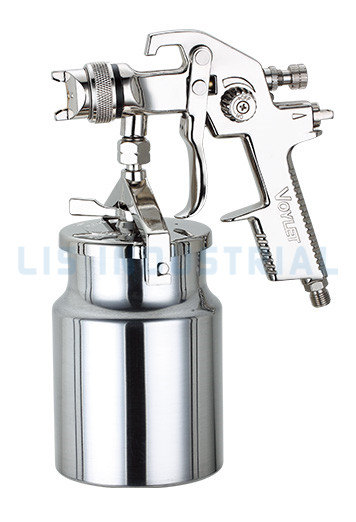
- 3 Gravity, Suction or Pressure Feed
- 4 HVLP, LVLP or Conventional: Read the Air Cap Pressure
- 5 Match the Gun to the Air Supply
- 6 Pick the Gun by the Job
- 7 What Separates a Reliable Gun From a Cheap One
- 8 A Five-Minute Buying Checklist
- 9 Frequently Asked Questions
- 9.1 What size spray gun do I need for car painting?
- 9.2 Is an HVLP spray gun better than a conventional gun?
- 9.3 What is the difference between gravity feed and suction feed spray guns?
- 9.4 What size air compressor do I need for an HVLP spray gun?
- 9.5 Can I spray latex paint or wall texture with a spray gun?
- 9.6 How do I know when to replace the needle and nozzle?
A furniture workshop replaced its worn suction gun with a new 1.4 mm gravity model and immediately got worse results: the sanding sealer sprayed dry and gritty, while the same gun laid lacquer down perfectly. Nothing was wrong with the tool. The fluid nozzle was simply too small for a sealer that measured around 30 seconds on a Zahn #2 cup.
That story is the whole of spray gun selection in miniature. A spray gun is never good or bad in the abstract; it is either matched or mismatched to a coating, a substrate and an air supply. Four numbers do most of the work: fluid nozzle and needle size, feed type, air cap pressure, and air consumption. Align those four with what you spray and what your compressor delivers, and almost any well-built gun will produce a professional finish.
This guide walks through those numbers in the order that matters, then covers feed systems, compressor sizing, application-specific picks, and the serviceability details that decide whether a gun still performs well three years from now.
The Four Numbers That Decide the Finish
Manufacturer spec sheets run long, but only four lines change what leaves the nozzle.
- Fluid nozzle and needle size. Written as 1.3 mm, 1.5 mm, 1.8 mm and so on, it sets fluid flow and droplet size. Needle and nozzle are a matched pair and are always replaced together.
- Feed type. Gravity (cup on top), suction (cup below) or pressure (a remote tank feeding the gun through a hose). The choice changes behaviour at different spray angles and with thicker materials.
- Air cap pressure and technology. Conventional guns atomise at 40 to 60 psi. HVLP and LVLP guns are defined by low air cap pressure, which raises transfer efficiency and cuts overspray.
- Air consumption in CFM at a stated inlet pressure. This is the figure your compressor must satisfy. A gun demanding 13 CFM from a compressor that delivers 8 CFM will never behave as advertised.
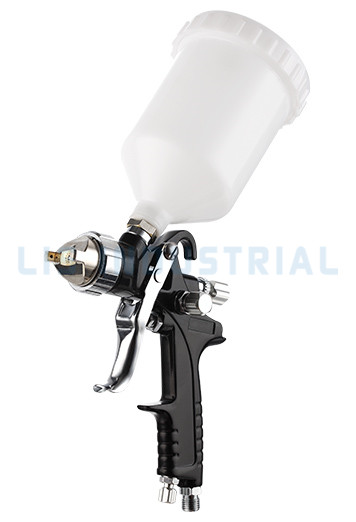
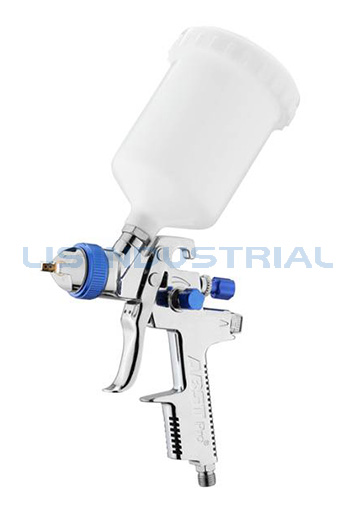
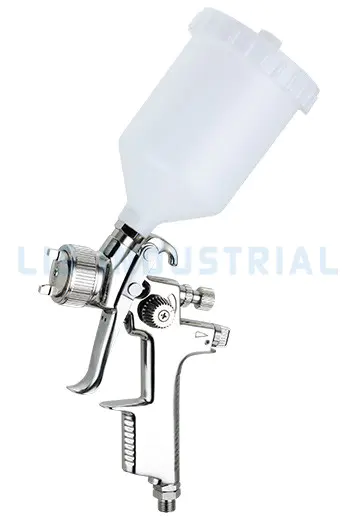
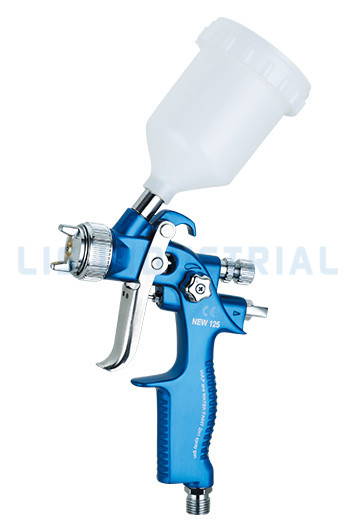
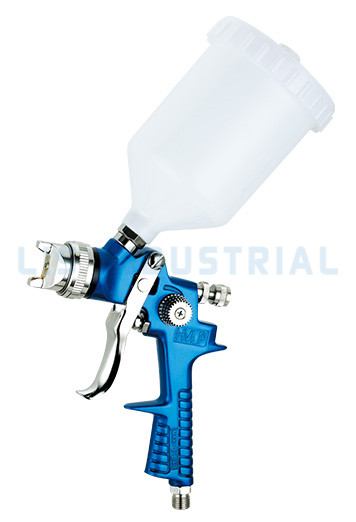
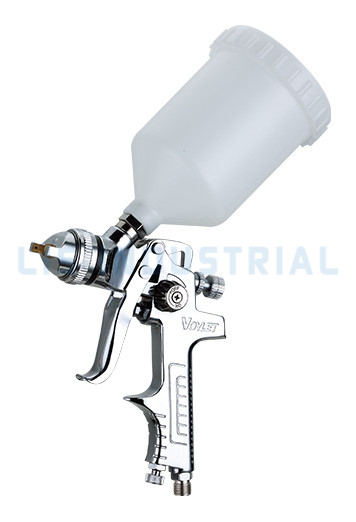
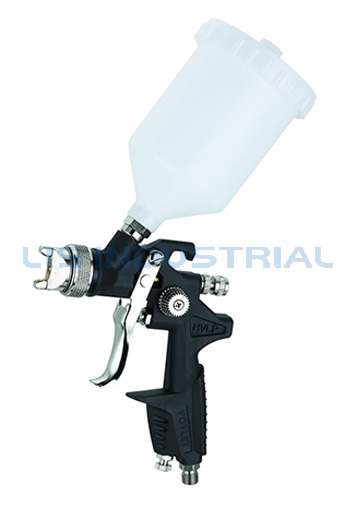
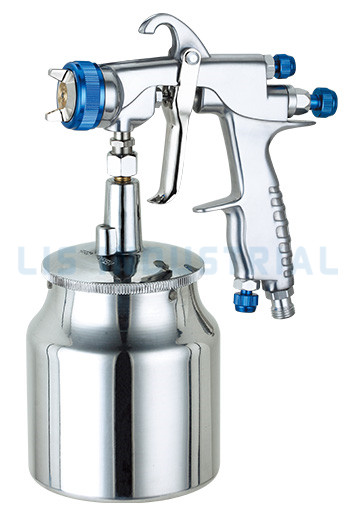
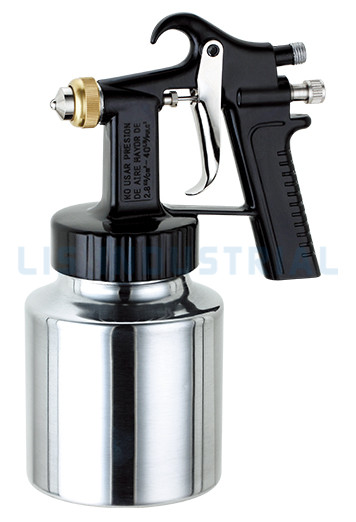
The figures below show where those specifications sit on the tool itself.
Every adjustment maps back to one of those numbers: the fluid knob controls needle travel, the pattern valve redistributes air at the cap, and the inlet regulator sets atomising energy.
Start With the Coating, Not the Gun
Hobby buyers shop by brand or price. Professionals shop by what goes into the cup. Viscosity, solid content and drying speed decide the nozzle size and the feed system long before brand enters the conversation.
The practical measurement is viscosity in seconds on a Zahn #2 cup, and most coating suppliers publish a target range on the datasheet. Thin materials need small nozzles so the gun does not flood the surface; high-solids primers need large ones or the fluid simply will not flow. Where thinning is permitted, thinning slightly is usually a better route than jumping to an oversized nozzle, because over-thinning alters the finish and slows coverage per pass.
| Coating | Typical viscosity (Zahn #2) | Nozzle size | Feed type |
| Dye stain, washcoat, thin lacquer | 12–18 s | 1.0–1.3 mm | Gravity, LVLP |
| Automotive basecoat | 14–20 s | 1.2–1.3 mm | Gravity, HVLP or LVLP |
| Clearcoat, single-stage topcoat | 18–25 s | 1.3–1.4 mm | Gravity, HVLP |
| Wood sealer, varnish, enamel | 25–35 s | 1.5–1.8 mm | Gravity or suction |
| Primer surfacer, high-build primer | 25–40 s | 1.6–1.8 mm | Pressure or gravity |
| Texture, elastomeric, roof coating | 60 s and above, or unthinned | 2.0–2.5 mm or hopper | Pressure, hopper |
Cold workshop temperatures raise viscosity and can make a correctly specified nozzle behave like an undersized one. Warming material to roughly 20 to 25 °C is often the cheapest fix available.
Gravity, Suction or Pressure Feed
Feed type decides how the coating reaches the nozzle, and that single difference changes ergonomics, fluid pressure and the range of materials a gun can handle.
| Feed system | How coating reaches the nozzle | Best for | Limits |
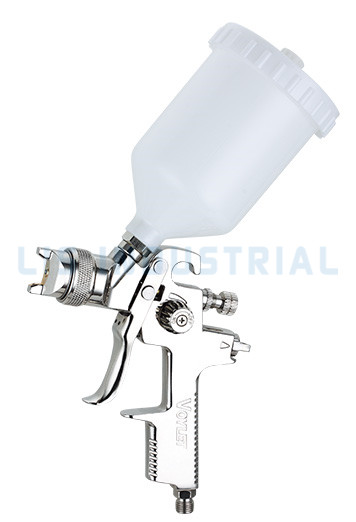
| Gravity | Cup sits above the nozzle; gravity plus slight vacuum | Refinish, wood finishing, detail work, lower pressure | Cup capacity of about 0.6–1.0 L limits long runs |
| Suction (siphon) | Cup below the nozzle; venturi vacuum lifts fluid | Large volumes of thin material, flat panels | Needs higher pressure and must stay fairly level |
| Pressure | Remote tank feeds fluid through a hose | Heavy coatings, industrial lines, long spray times | Extra equipment, longer setup and cleaning |
For most workshop and refinish work, a gravity feed spray gun is the default: it atomises at low pressure, cleans quickly and sprays at any angle, including overhead. Suction guns remain sensible where large volumes of thin material are applied flat. Pressure feed becomes the only realistic option once the coating is heavy, the spray time per part is long, or the gun runs on a production line where the operator should not be refilling a cup.
HVLP, LVLP or Conventional: Read the Air Cap Pressure
Air cap pressure determines how much paint actually lands on the part. Under the SCAQMD and CARB rules widely referenced across North America, an HVLP gun atomises at 10 psi or less at the air cap, while a conventional gun may run at 40 to 60 psi and throw a large share of the coating into the booth filters as overspray.
Typical transfer efficiency by gun type
Mid-range values commonly cited in coating-efficiency and air-quality literature; actual figures vary with coating, settings and operator technique.
Transfer efficiency is not an abstract number. Moving from roughly 30 percent to 65 percent means less material bought, less masking, fewer filter changes and a cleaner booth, which is why low-pressure guns are written into so many regional compliance rules.
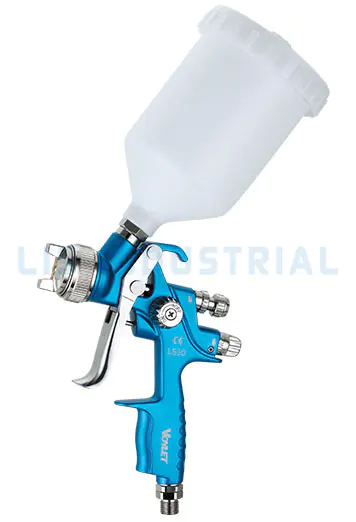 Voylet LS30 Pneumatic HVLP Gravity Feed Air Spray Gun 20oz CupApplications ・ Plastic Coating ・ Automotive Coating ・ Metal Coating ・ Woodwork CoatingView Product →
HVLP remains the standard choice for solvent-borne topcoats where a compliant booth and a compressor of adequate size are already in place. LVLP sits between the two worlds: much lower air consumption, often 4 to 8 CFM, at a moderate air cap pressure. Where the compressor is small or the work is detail-oriented, an LVLP spray gun will finish a panel that would starve and spit from an HVLP model.
Match the Gun to the Air Supply
Air supply is where most disappointing purchases are decided. Compressors are sold on displacement, not free air delivery, and the gap between the two is real: a unit advertised at 14 CFM typically delivers closer to 9 or 10 CFM at 90 psi.
Typical air consumption at working pressure (CFM)
Mid-range figures for representative models; always read the CFM rating at the inlet pressure you intend to use, not at the maximum.
A workable rule is to choose a compressor whose free air delivery exceeds the gun's rated CFM by at least 30 percent, then keep the run short and the hose fat. A 3/8 inch hose at 25 feet holds pressure far better than a 1/4 inch hose at 50 feet. Fit the filter-regulator at the gun end rather than the compressor end, so the pressure you set is the pressure the gun actually sees.
Moisture and oil are the other half of air quality. A coalescing filter plus a desiccant or refrigerated dryer removes the water that causes fisheyes and the oil that ruins adhesion, and it costs far less than a repaint.
Pick the Gun by the Job
Automotive refinish and spot repair
Basecoat normally runs through a 1.2 to 1.3 mm nozzle, clearcoat through 1.3 to 1.4 mm, both on a gravity-fed HVLP or LVLP gun at around 25 to 29 psi inlet pressure. Spot repair, jambs and blends reward a dedicated detail gun with a 0.8 to 1.0 mm nozzle, which keeps fluid volume low and makes blending far easier to control.
 F2 Gravity Feed Mini Air Paint Spray Gun AirbrushFluid Nozzle(mm)(etc):0.5View Product →
Furniture and woodworking
Lacquers and stains sit in the 1.3 to 1.5 mm range, while high-build sealers and pigmented varnishes need 1.5 to 1.8 mm. Wood shops gain twice from low-pressure guns: less material wasted on overspray, and less air moving through the booth, which means less airborne dust settling into the wet film.
 MGQ300Fluid Nozzle(mm)(etc):1.3View Product →
Texture, industrial coating and fine detail
Wall texture and elastomeric coatings call for a hopper or pressure-fed gun with a 2.0 to 2.5 mm tip. Automated production lines use automatic guns triggered by a controller, where consistency matters more than operator feel. Airbrushes, at 0.2 to 0.5 mm, are a separate discipline entirely.
What Separates a Reliable Gun From a Cheap One
Once the specifications match the job, the difference between a tool that lasts five years and one that lasts five months is serviceability. Check these points before ordering:
- Needle, nozzle and air cap sets are available as spares, so wear parts can be replaced instead of the whole gun.
- Seals and packings in the fluid path are solvent-resistant, typically PTFE or a fluoroelastomer.
- The body is machined rather than cast with visible porosity around fluid passages.
- The maker works to a documented quality system. LIS, for example, states that it follows ISO 9000 requirements, performs 100 percent function testing before packing, and holds CE and GS certification on relevant models.
- Thread and inlet standards match your region, whether that is G 1/4 or NPT, along with the regional kit you buy.
A Five-Minute Buying Checklist
- Write down the coating you spray most often, its viscosity and its solid content.
- Select the nozzle size from the coating table above, then confirm the supplier stocks that needle and nozzle set.
- Choose the feed system from your working position, part size and daily volume.
- Confirm the required CFM and air cap pressure, then compare them against your compressor's free air delivery.
- Verify spares, seals, thread standard and certification before you order the first unit.
Frequently Asked Questions
What size spray gun do I need for car painting?
Most refinish work uses a 1.2–1.3 mm nozzle for basecoat and 1.3–1.4 mm for clearcoat on a gravity-fed HVLP or LVLP gun, usually at 25–29 psi inlet pressure.
Is an HVLP spray gun better than a conventional gun?
For most shop work, yes. HVLP typically delivers 65 percent or more of the coating to the surface against roughly 25–40 percent for conventional high-pressure guns, which means less overspray and lower material cost.
What is the difference between gravity feed and suction feed spray guns?
Gravity guns hold the cup above the nozzle and work at lower pressure in any position. Suction guns pull material up from a cup below the nozzle, need higher pressure, and should stay fairly level.
What size air compressor do I need for an HVLP spray gun?
Match free air delivery, not tank size. A gun consuming 11 CFM needs roughly 14–16 CFM of free air delivery to run continuously. Small 2–3 HP units usually cannot keep up on full panels.
Can I spray latex paint or wall texture with a spray gun?
Yes, but not with a standard 1.4 mm automotive setup. Use a 2.0–2.5 mm nozzle, or a hopper or pressure-fed texture gun, and expect to thin latex slightly.
How do I know when to replace the needle and nozzle?
When the pattern turns uneven, fluid output drops at the same setting, or the fan develops tails that pattern adjustment can no longer correct. Wear is gradual, so keep a new set for comparison.