 Search
 English
 中文简体
中文简体 Deutsch
 Español
Content
- 1 Can HVLP Spray Guns Save Paint and Improve Efficiency? The Direct Answer
- 2 How HVLP Technology Reduces Overspray at the Physics Level
- 3 Transfer Efficiency Comparison: HVLP vs. Other Spray Methods
- 4 Key Components of an HVLP Spray Gun and Their Functions
- 5 Setting Up an HVLP Spray Gun for Maximum Paint Savings
- 6 Industries and Applications Where HVLP Spray Guns Deliver the Most Value
- 7 Maintaining an HVLP Spray Gun to Preserve Efficiency Over Time
- 8 Frequently Asked Questions About HVLP Spray Guns
Can HVLP Spray Guns Save Paint and Improve Efficiency? The Direct Answer
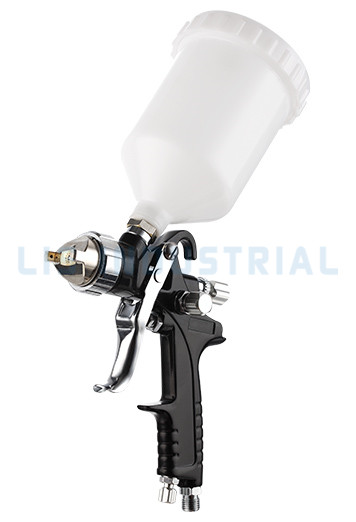
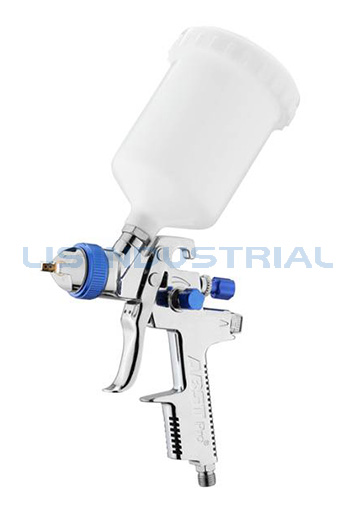
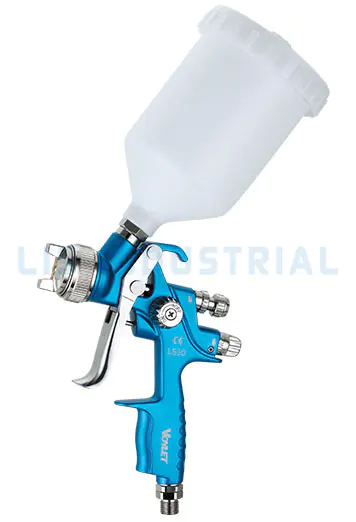
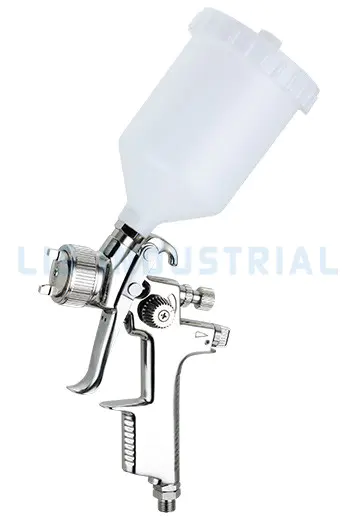
Yes — an HVLP Spray Gun delivers a measurable and well-documented improvement in both paint utilization and finishing efficiency. HVLP technology (High Volume Low Pressure) achieves transfer efficiency of 65–85%, meaning 65 to 85 cents of every dollar spent on paint actually reaches the surface. Conventional high-pressure spray guns, by comparison, typically achieve only 25–40% transfer efficiency, wasting the majority of material as overspray. For any professional finishing operation — automotive refinishing, furniture manufacturing, metal fabrication, or industrial coating — this difference translates directly into lower material consumption, faster compliance with VOC regulations, and a cleaner working environment.
The efficiency gains from an HVLP Spray Gun are not theoretical. Regulatory bodies including the United States Environmental Protection Agency (EPA) and the South Coast Air Quality Management District (SCAQMD) mandate HVLP or equivalent technology in many industrial spray finishing applications precisely because of its demonstrated ability to reduce solvent and coating emissions by 50–60% compared to conventional air atomization. Understanding how HVLP achieves these results — and how to set it up correctly — is the foundation of any efficient finishing operation.
How HVLP Technology Reduces Overspray at the Physics Level
The core principle of an HVLP Spray Gun is atomization at low air pressure — defined in most regulatory standards as 10 psi (0.7 bar) or less at the air cap — using a high volume of air to break the fluid stream into fine droplets. This is fundamentally different from conventional spray guns, which use high pressure (40–60 psi at the cap) to achieve atomization.
Why Low Cap Pressure Matters for Transfer Efficiency
When compressed air exits a conventional gun's air cap at high velocity, it creates turbulence around the spray jet that deflects fine paint droplets away from the target surface — a phenomenon called bounceback. At 10 psi cap pressure, the air velocity is significantly lower, and the droplets have enough mass relative to air velocity to follow a more direct path to the surface rather than being deflected. This fundamental aerodynamic difference is why HVLP achieves dramatically higher transfer efficiency at equivalent atomization quality.
The Role of High Air Volume
To atomize adequately at low pressure, HVLP guns require substantially more air volume — typically 12–25 CFM (340–700 L/min) compared to 4–9 CFM for a conventional gun at the same fluid delivery rate. This high air volume maintains droplet size and pattern width without relying on high pressure. It also explains why HVLP guns require a compressor or turbine rated for their specific air volume demand — a compressor correctly sized for conventional guns is often undersized for HVLP use.
Droplet Size and Surface Finish Quality
HVLP atomization produces droplets in the 30–80 µm range — fine enough for smooth film formation but controlled enough to minimize misting. Conventional high-pressure guns at equivalent fluid flow produce a broader droplet size distribution with more ultra-fine particles (under 10 µm) that remain airborne indefinitely and contribute to both material waste and respiratory hazard. The more uniform droplet spectrum from HVLP also contributes to better film build per pass and reduced dry spray defects.
Transfer Efficiency Comparison: HVLP vs. Other Spray Methods
Transfer efficiency — the percentage of atomized coating that actually deposits on the target — is the primary metric for evaluating spray gun material savings. The following data represents industry-standard measurements across spray technologies.
Values represent typical ranges for flat panel spraying at recommended gun-to-target distance
A practical example illustrates the financial significance of this data. A furniture manufacturer consuming 200 liters of lacquer per week at 30% transfer efficiency (conventional gun) wastes approximately 140 liters as overspray. Switching to an HVLP Spray Gun at 75% transfer efficiency reduces waste to approximately 50 liters — a material saving of 90 liters per week, with proportional reductions in solvent disposal costs, booth filter replacement frequency, and VOC emissions.
| Spray Method | Air Cap Pressure | Air Consumption | Finish Quality | Best Use |
|---|---|---|---|---|
| Conventional air spray | 40–60 psi | 4–9 CFM | Excellent | High-speed production, complex parts |
| HVLP Spray Gun | 2–10 psi | 12–25 CFM | Excellent | Finishing, automotive, furniture, detail work |
| Airless spray | N/A (fluid pressure) | Low | Good–Moderate | High-build coatings, large surfaces |
| LVLP | 10–25 psi | 6–12 CFM | Very good | Small compressor environments, touch-up |
Key Components of an HVLP Spray Gun and Their Functions
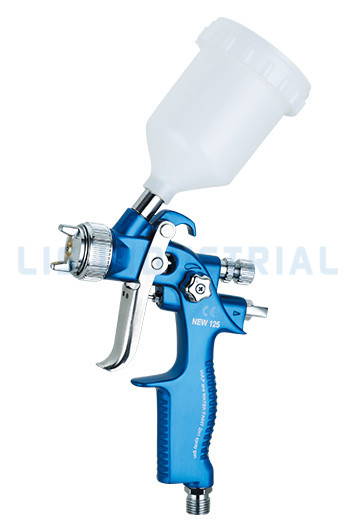
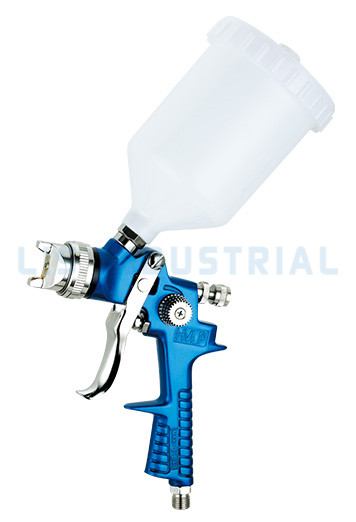
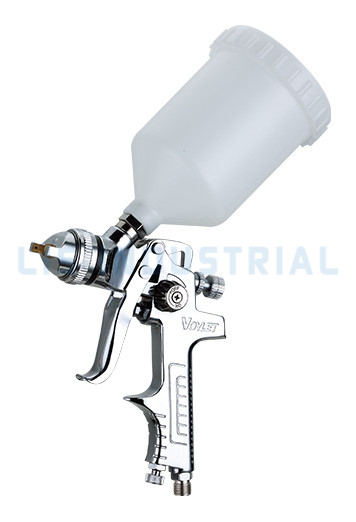
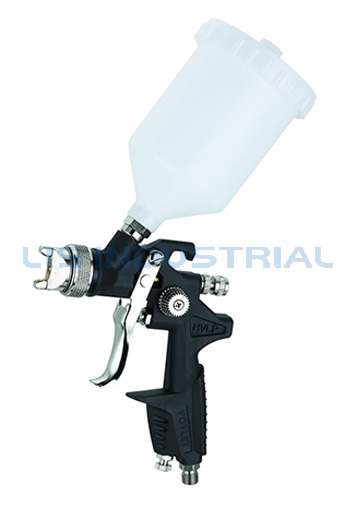
Understanding the design of an HVLP Spray Gun helps operators set up and maintain equipment correctly, which directly affects efficiency and finish quality.
Air Cap
The air cap is the most critical component for atomization quality. It determines pattern shape (round or fan), fan width, and atomization fineness. HVLP air caps are designed with enlarged air horn ports to deliver sufficient air volume at low pressure. Replacing an HVLP air cap with a conventional high-pressure cap on the same gun body will defeat the HVLP function entirely, increasing both cap pressure and overspray.
Fluid Needle and Nozzle
The fluid needle and nozzle form a precision metering pair that controls fluid flow rate. Nozzle orifice sizes range from 0.8 mm to 2.5 mm for most HVLP applications:
- 0.8–1.0 mm: Thin materials — dyes, stains, sealers, detail basecoat work
- 1.2–1.4 mm: Automotive basecoats, waterborne topcoats, single-stage automotive enamels
- 1.4–1.8 mm: Automotive primers, higher-viscosity lacquers, furniture topcoats
- 2.0–2.5 mm: High-build primers, texture coatings, thicker industrial coatings
Gravity Feed vs. Suction Feed Cups
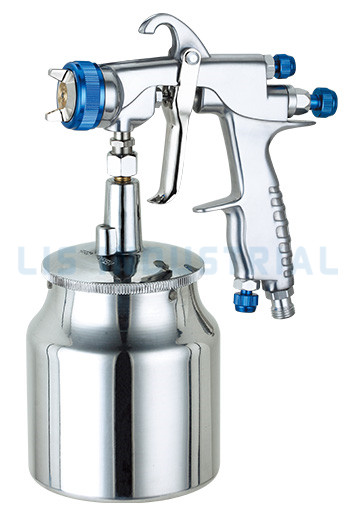
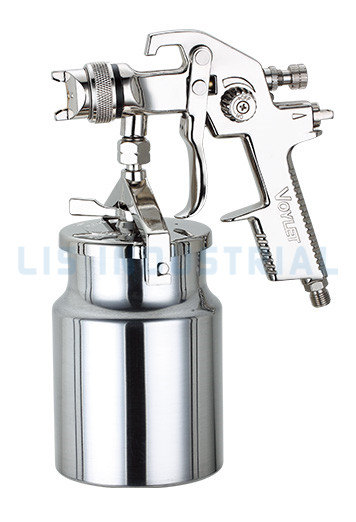
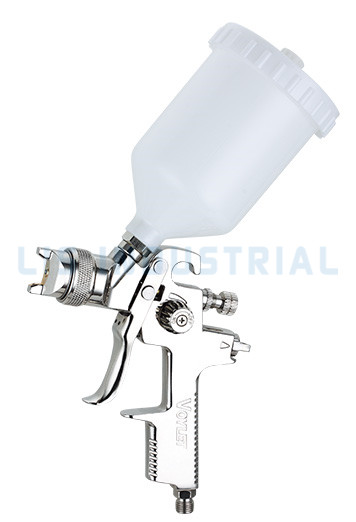
Gravity-feed is the dominant professional choice for finishing work because the fluid flows by gravity to the nozzle, enabling consistent delivery at lower air pressures and reducing the minimum fluid level needed to spray effectively.
Setting Up an HVLP Spray Gun for Maximum Paint Savings
The efficiency gains of HVLP technology are only realized when the gun is correctly set up for the specific material, substrate, and application conditions.
Fluid Viscosity and Thinning
Most HVLP guns perform optimally with materials thinned to 20–30 seconds in a No. 4 Ford cup (DIN 4) at the spraying temperature. Coatings that are too thick produce coarse atomization and orange peel texture; coatings thinned beyond the recommended range lose film build per pass.
Gun-to-Target Distance
The correct spraying distance for most HVLP Spray Guns is 150–200 mm (6–8 inches) from the surface. At closer distances, excessive film build per pass causes runs; beyond 250 mm, droplets partially dry before reaching the surface, creating rough texture and dramatically reducing transfer efficiency.
Transfer efficiency peaks at 150–200mm; both closer and farther distances reduce material utilization significantly
Air Supply Pressure
The inlet pressure at the gun handle — measured with a gauge at the gun inlet — should be set to the manufacturer's recommended range, typically 25–45 psi (1.7–3.1 bar) for most HVLP gravity-feed guns. This inlet pressure produces the correct 10 psi or below at the air cap after losses through the gun body passages.
Industries and Applications Where HVLP Spray Guns Deliver the Most Value
Automotive Refinishing: HVLP guns are mandated by law in many US states for automotive refinishing. A typical body shop can reduce solvent-borne basecoat consumption by 30–40% per repair job by switching from conventional to HVLP application.
Wood and Furniture Finishing: Production line cabinet shops operating 8 hours per day typically report finish material savings of 25–35% after converting from conventional spray to HVLP, with finish quality remaining equivalent.
Metal Fabrication and General Industrial Coating: For parts with complex geometry, HVLP's reduced bounceback improves penetration into inside corners and recesses, reducing holiday defects that require rework.
Aerospace and Precision Component Finishing: HVLP guns with precision needle control provide the film thickness control required (±5 µm tolerances) while minimizing waste of expensive aerospace-grade coatings.
Maintaining an HVLP Spray Gun to Preserve Efficiency Over Time
- After each use: Flush the fluid passage immediately with the appropriate solvent. Remove the air cap and soak in solvent, using a soft bristle brush to clear all air ports.
- Weekly: Disassemble the needle and nozzle assembly, inspect the needle tip for wear or damage, and clean the nozzle seat with a cotton swab.
- Monthly: Inspect all O-rings and packings for swelling, cracking, or compression set. Replace any seals that show degradation.
- Quarterly: Perform a spray pattern test on a test panel at standard setup conditions to detect any distortion or asymmetry.
- Annually: Replace the complete needle-nozzle set as a matched pair to preserve fluid metering accuracy.
Frequently Asked Questions About HVLP Spray Guns
Most professional HVLP guns require between 12 and 25 CFM of sustained air delivery at 30–40 psi. A compressor delivering at least 15 CFM at 40 psi is a practical starting point. Turbine-driven HVLP systems bypass the compressor requirement entirely.
Yes, with the correct nozzle size (1.8–2.5 mm) and proper thinning. High-build primers require careful viscosity adjustment; warming the material may also help with atomization.
HVLP is widely used with waterborne coatings. Use guns with stainless steel or plastic fluid passages to prevent corrosion, and flush thoroughly with water after each session.
Partial blockage of air horn ports is the most common cause. Clean the air cap thoroughly with solvent and a soft brush. Also verify inlet pressure and material viscosity.
LVLP guns use lower air consumption (6–12 CFM) and work well with smaller compressors, achieving 60–75% transfer efficiency. HVLP typically offers slightly better atomization for high-viscosity coatings.
Measure air cap pressure using a calibrated gauge inserted into the center air port while the gun is operating. The measured cap pressure must be 10 psi or below to meet HVLP regulatory definition.