 Search
 English
 中文简体
中文简体 Deutsch
 Español
Content
- 1 How HVLP Technology Works and Why It Matters
- 2 Key Factors to Evaluate When Choosing an HVLP Spray Gun
- 3 Product Lineup Overview: Voylet and Lis HVLP Spray Guns
- 4 HVLP Spray Gun Setup Guide: Step-by-Step for Best Results
- 5 Best HVLP Spray Gun for Automotive Painting: What Professionals Look For
- 6 HVLP Spray Gun Troubleshooting: Common Issues and Practical Solutions
- 7 How to Clean an HVLP Spray Gun Properly
- 8 Global Reach and OEM Capability: Ningbo Lis Industrial Co., Ltd
- 9 HVLP Spray Gun for Beginners: Getting Started Without Frustration
- 10 Frequently Asked Questions About HVLP Spray Guns
When it comes to achieving a flawless, professional-grade finish on any surface, the right HVLP spray gun makes all the difference. HVLP — High Volume Low Pressure — technology delivers paint at reduced air pressure, which significantly minimizes overspray, reduces material waste, and produces a smoother, more even coat compared to conventional spray guns. Whether you are tackling automotive bodywork, furniture refinishing, cabinetry, or industrial coatings, selecting the correct HVLP gun determines the quality of your results.
The direct answer: the best HVLP spray gun depends on your specific application. For Best HVLP spray gun for automotive painting, you need precise atomization and a wide fan pattern. For the Best HVLP spray gun for beginners, ease of adjustment and simple maintenance are priorities. For industrial or OEM use, durability, fluid nozzle flexibility, and consistent output across long production runs are critical. Below, we break down every factor that separates a truly excellent HVLP gun from an average one — with real data, product comparisons, and practical guidance.
Ningbo Lis Industrial Co., Ltd, a leading HVLP spray gun factory in China and professional Wholesale HVLP spray gun supplier, has engineered a full lineup of gravity-feed and pneumatic HVLP spray guns that serve professionals across Europe, North America, the Middle East, South Africa, and East Asia. All products carry CE and GS certifications, ensuring they meet rigorous international safety and quality standards.
How HVLP Technology Works and Why It Matters
HVLP spray guns operate by converting compressed air into a high-volume, low-pressure stream — typically at or below 10 PSI at the air cap — which carries atomized paint particles to the surface with much greater transfer efficiency than traditional high-pressure systems. Conventional spray guns often achieve only 25–40% transfer efficiency, meaning a large proportion of paint becomes airborne waste. HVLP systems, by contrast, routinely achieve 65–85% transfer efficiency, which translates directly into reduced material costs, less environmental impact, and cleaner working conditions.
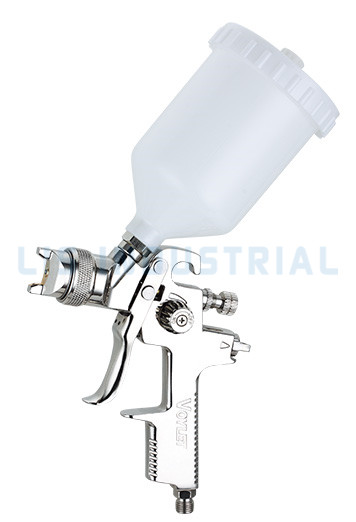
The gravity-feed design — where the paint cup sits on top of the gun body — is the most popular configuration in professional and semi-professional use today. Gravity naturally assists paint flow to the fluid tip, which means the gun requires less air pressure to atomize material, further improving efficiency and reducing the risk of spray gun spitting caused by inconsistent paint delivery. This design also allows the user to work with smaller quantities of paint without run-out issues.
Understanding HVLP spray gun pressure settings is essential. Running too high an inlet pressure can cause turbulence at the cap and produce an uneven spray pattern. Running too low creates insufficient atomization, leading to coarse droplets, drips, or an orange peel finish. Most professional applications fall within a 25–50 PSI inlet range, with the cap pressure regulated below 10 PSI by the gun's internal passages.
HVLP gravity-feed guns lead all spray technologies in material transfer efficiency, averaging around 82%. This significantly outperforms conventional high-pressure guns (around 30%) and airless systems (around 46%), meaning less paint is wasted as overspray. Higher efficiency reduces both material costs and environmental impact over time, making HVLP the preferred choice for professionals in automotive, woodworking, and industrial finishing.
Key Factors to Evaluate When Choosing an HVLP Spray Gun
Selecting the right HVLP gun is not a single-variable decision. The following criteria interact with one another and must be evaluated together based on your intended application, the coatings you use, and how frequently you spray.
Fluid Nozzle Size
Nozzle size is arguably the most important specification. A nozzle that is too small for a thick coating will clog; one that is too large for a thin, water-borne product will produce excessive dripping or paint dripping from the spray gun. Consulting an HVLP spray gun nozzle size chart before selecting a gun for a specific material is a practice every professional should follow.
| HVLP Spray Gun Nozzle Size Chart — matched to common coating types and applications | ||
| Nozzle Size (mm) | Recommended Materials | Typical Application |
| 0.5 – 0.8 mm | Stains, dyes, thin lacquers | Detail work, woodworking |
| 1.0 – 1.3 mm | Waterborne basecoats, primers | Automotive basecoat, furniture |
| 1.4 – 1.7 mm | Solvent-based enamels, urethanes | Automotive topcoat, industrial |
| 1.8 – 2.5 mm | Heavy primers, sealers, latex | Bodywork primer, walls |
Cup Capacity and Material
Cup size affects how long you can spray without refilling. Automotive panel work typically benefits from a 600ml cup, while detail or touch-up jobs are better handled with a 125ml cup that reduces weight and gives you more precise control. Aluminum cups resist most solvents and are easier to clean than plastic; some applications require solvent-resistant materials throughout.
Air Consumption (CFM)
Always verify that your air compressor can continuously supply the gun's required CFM (cubic feet per minute). Running a gun on an undersized compressor causes pressure fluctuations that lead directly to uneven spray pattern problems. Most professional HVLP guns require 6–14 CFM at 29–50 PSI. Mini or touch-up guns may work with as little as 3–4 CFM.
Body Construction and Durability
Professional spray gun bodies should be cast from gravity die-cast aluminum alloy. Cheaper zinc-alloy bodies corrode faster with solvent exposure and may warp under temperature changes. The needle, nozzle, and air cap set should be precision-ground stainless steel to minimize wear and ensure that the fluid passages stay true over thousands of spray cycles.
Product Lineup Overview: Voylet and Lis HVLP Spray Guns
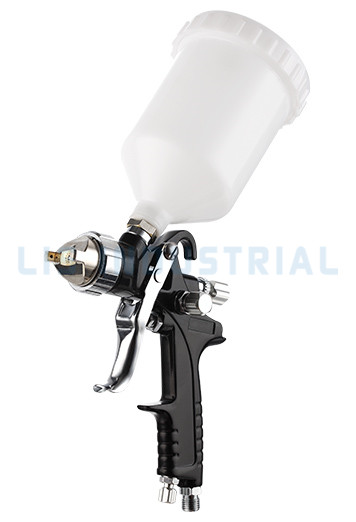
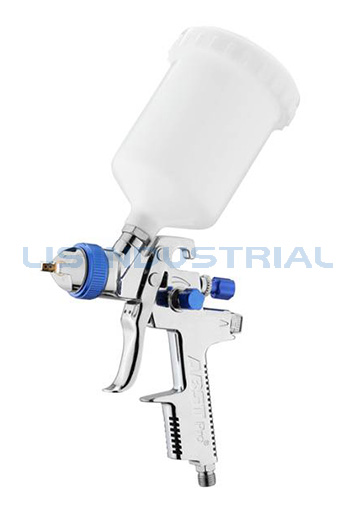
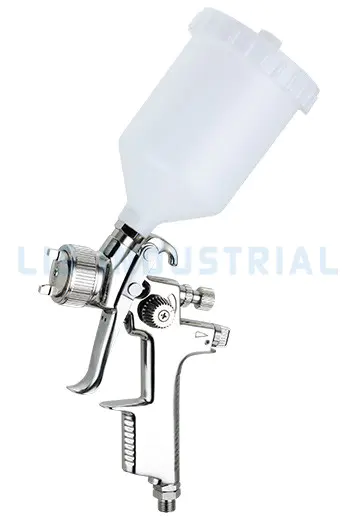
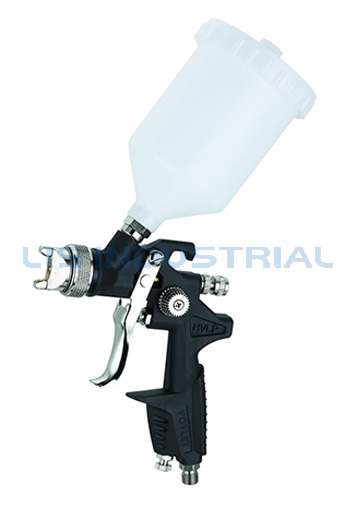
Ningbo Lis Industrial Co., Ltd manufactures a comprehensive range of HVLP spray guns under the Voylet brand and house model designations, covering applications from compact detail work to full automotive panel spraying. As a certified Custom HVLP spray gun OEM manufacturer, Lis also provides full ODM and OEM services, allowing customers to specify cup sizes, nozzle configurations, color finishes, and branding.
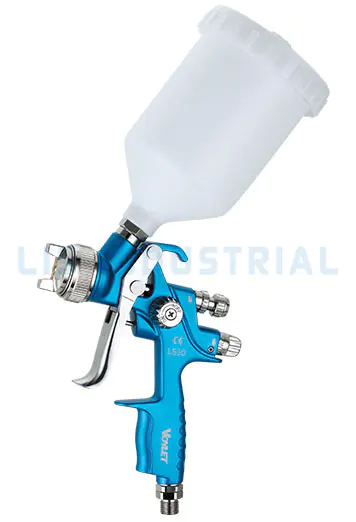
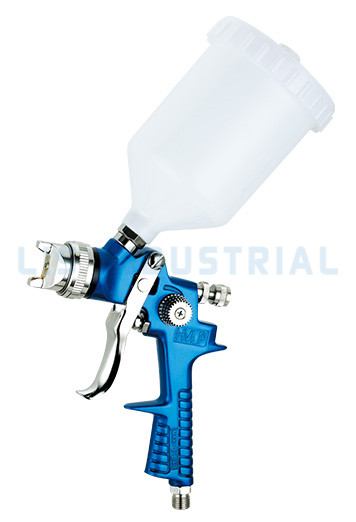
- Voylet LS30 Pneumatic HVLP Gravity Feed Air Spray Gun 20oz Cup — A full-size professional gun with a 20oz (approximately 590ml) aluminum cup, designed for high-volume automotive and industrial painting. The LS30's gravity-feed system ensures consistent material delivery across large panels.
- ST2001 — A versatile mid-range gravity-feed gun suited to both waterborne and solvent-based coatings, with adjustable fan, fluid, and air controls for fine-tuned output.
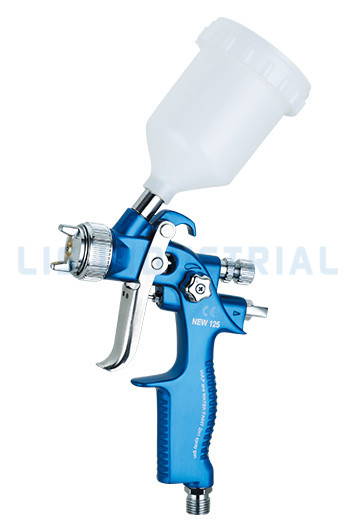
- N125 HVLP Spray Gun 0.5/0.8/1.0mm Nozzle with 125ml Cup — A compact, lightweight detail gun that ships with three interchangeable nozzle tips (0.5mm, 0.8mm, and 1.0mm). The small 125ml cup is ideal for touch-ups, staining, and precision decorative work.
- H881 HVLP Spray Gun Gravity Feed Paint Sprayer — Built for smooth, consistent atomization with an ergonomic body design that reduces hand fatigue during extended sessions.
- AS1001 HVLP Gravity Feed Air Spray Gun — A reliable workhorse model combining solid aluminum construction with intuitive controls, suited to workshops requiring a dependable daily driver.
- P827 — A precision atomization gun designed for high-performance clearcoats and fine finishes, where surface texture must meet the tightest standards.
- N2001 — A professional-grade full-size model engineered for demanding industrial environments, offering robust build quality and long service life.
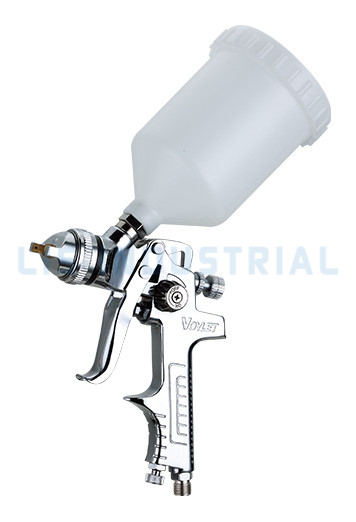
- Voylet H827 HVLP Air Spray Gun Paint Sprayer 600ml Gravity Feed — The H827's 600ml cup and high-efficiency atomization system make it a standout choice for full-panel automotive painting. The gravity-feed design ensures material flows smoothly even at lower inlet pressures.
- HK827 — A variant of the 827 platform optimized for specific regional markets and specialized coating formulations.
- H2001/H2000 Mini HVLP Spray Paint Gun Gravity Feed Sprayer Repair Tool — A compact mini gun designed for small-area repairs, model painting, and touch-up work where full-size guns are impractical. Despite its small size, the H2001/H2000 delivers surprisingly smooth atomization and is a popular choice as the Best HVLP spray gun for beginners learning spray technique on manageable areas.
The radar chart compares the Voylet H827 full-size 600ml gun with the compact H2001 Mini across six performance dimensions. The H827 excels in atomization quality, cup capacity, and durability — attributes critical for production-level automotive painting. The H2001 Mini, on the other hand, scores highest in ease of use and value, making it an outstanding entry-level tool for beginners and technicians handling smaller repair areas. Both models share a solid versatility profile, reflecting Lis's commitment to broad coating compatibility across its product range.
HVLP Spray Gun Setup Guide: Step-by-Step for Best Results
Even the highest-quality HVLP spray gun will underperform if it is set up incorrectly. Following a consistent HVLP spray gun setup guide before every spray session is one of the most effective habits a painter can develop. The steps below apply broadly across gravity-feed guns and represent industry-standard practice.
- Check and filter the air supply. Install an inline moisture/oil separator between the compressor and gun. Moisture contamination is a leading cause of fisheye defects and paint cratering. Drain the compressor tank before starting.
- Thin the coating to the correct viscosity. Use a viscosity cup (typically a Ford #4 cup) to measure material. Most solvent-based automotive topcoats spray well between 16–22 seconds; waterborne products often need less thinning. Incorrect viscosity is the most frequent cause of an uneven spray pattern.
- Select and install the correct nozzle set. Refer to the HVLP spray gun nozzle size chart above. Ensure the needle, nozzle, and air cap are matched to the same size specification. Mixing sizes causes leakage and erratic spray patterns.
- Set inlet pressure at the gun. Attach a regulator directly at the gun handle. Start with the manufacturer's recommended inlet PSI (typically 25–35 PSI for most HVLP gravity guns) and adjust from there based on atomization quality in test sprays.
- Adjust fan width, fluid flow, and air volume. Set fan to maximum, fluid needle to roughly two-thirds open, and air volume to full. Spray a test pattern on cardboard. A well-formed ellipse without heavy edges or a "banana" shape confirms proper setup.
- Test spray on scrap material. Evaluate atomization, wetness, and pattern. Adjust fluid flow or pressure as needed. Only move to the actual workpiece when the test pattern is satisfactory.
- Maintain a consistent gun-to-surface distance. The standard range is 6–8 inches for automotive work. Moving closer increases wetness and drip risk; moving farther reduces film build and can cause dry spray.
This representative curve illustrates how atomization quality improves as inlet pressure rises from 10 PSI, peaks within the 25–45 PSI range, and then begins to decline at higher pressures where turbulence at the air cap disrupts the spray pattern. Running a gun at excessively high pressure does not improve quality — it actually introduces problems such as excessive overspray, paint dripping from the spray gun, and a rougher surface texture resembling an orange peel finish. The optimal zone highlighted in this chart aligns with standard HVLP pressure settings recommended by professional painters and coating manufacturers.
Best HVLP Spray Gun for Automotive Painting: What Professionals Look For
Automotive finishing is one of the most demanding environments for any spray gun. The surfaces are large, the coatings are complex (primers, sealers, basecoats, clearcoats), and the standards are unforgiving — even a slight inconsistency in atomization or fan pattern produces visible defects in the final gloss. Finding the Best HVLP spray gun for automotive painting means balancing atomization fineness, fan pattern width, material capacity, and ergonomic endurance.
Automotive body technicians typically look for the following specifications:
- Fan width of 250–300mm at standard working distance, allowing full coverage of wide body panels in fewer passes
- 1.3–1.4mm nozzle for waterborne basecoats; 1.4–1.6mm for solvent-borne urethane clearcoats
- Minimum 500ml cup capacity for full-panel work without disruptive refills
- Stainless steel fluid passage to resist the aggressive solvents used in automotive-grade clearcoats
- Fine, even atomization that produces a wet, flat lay-down without requiring excessive reduction
The Voylet H827 HVLP Air Spray Gun with 600ml Gravity Feed cup addresses all of these requirements. Its 600ml aluminum cup eliminates mid-panel refill stops, its precision-ground stainless fluid set handles both waterborne and solvent formulas, and its ergonomic handle reduces fatigue during full-vehicle paint jobs that may last several hours. The H827 is equally capable when used with the HK827 variant configuration for regional-specific coating systems.
This column chart compares the maximum fan width achievable across six Lis/Voylet HVLP spray gun models. Larger fan widths reduce the number of passes required to cover a surface, which increases painting speed and improves pattern consistency on large panels. The H827 leads with a 300mm maximum fan, making it the most efficient choice for full-body automotive work. Smaller models like the H2001 and N125 are purpose-built for precision areas where a wide fan would cause overspray on adjacent surfaces.
HVLP Spray Gun Troubleshooting: Common Issues and Practical Solutions
Even with careful setup, spray gun problems can arise. Knowing how to diagnose and resolve them quickly is a skill that separates experienced professionals from beginners. This HVLP spray gun troubleshooting reference covers the most frequent issues encountered in real-world spraying.
Spray Gun Spitting
Spray gun spitting refers to intermittent bursts of paint rather than a steady stream. The most common cause is air entering the fluid passage — either through a loose nozzle, a worn needle packing, or low paint level in the cup. Check that the nozzle is torqued correctly (finger-tight plus one-eighth turn), replace needle packing if worn, and ensure the cup is at least one-quarter full. Solvents that have partially dissolved internal seals can also cause spitting; replacing o-rings and seals at regular intervals prevents this.
Uneven Spray Pattern
An uneven spray pattern — appearing as a heavy center, heavy edges, or a crescent shape — usually indicates a partially blocked air cap port, incorrect pressure, or imbalanced air cap installation. Remove and clean the air cap with the appropriate solvent, using a soft brush or toothpick for individual ports. Never use metal tools inside air cap holes as they enlarge passages and permanently alter the spray pattern. After cleaning, rotate the air cap 180 degrees and test spray; if the pattern problem reverses direction, the cap is the cause.
Orange Peel Finish
An orange peel finish is characterized by a bumpy, textured surface resembling citrus skin. It develops when atomized droplets do not flow out fully before the solvent flashes off — most often caused by material that is too thick, an air pressure that is too high (causing premature drying), insufficient gun-to-surface distance, or an ambient temperature that accelerates flash time. Solutions include: reducing the coating to the correct viscosity, lowering inlet pressure by 5 PSI increments until droplets flow together, moving 1–2 inches closer to the surface, or switching to a slower-evaporating solvent in hot conditions.
Paint Dripping from Spray Gun
Paint dripping from the spray gun — specifically from the nozzle tip — indicates that the needle is not seating properly against the nozzle. Causes include a bent needle, debris lodged in the nozzle orifice, or worn needle packing that allows forward migration. Disassemble the fluid set, clean the nozzle with the correct solvent, inspect the needle tip for bending or scoring, and replace any worn components. This issue can also occur when the fluid needle adjustment knob is not fully closed between passes.
| HVLP Spray Gun Nozzle Size Chart — matched to common coating types and applications | ||
| Nozzle Size (mm) | Recommended Materials | Typical Application |
| 0.5 – 0.8 mm | Stains, dyes, thin lacquers | Detail work, woodworking |
| 1.0 – 1.3 mm | Waterborne basecoats, primers | Automotive basecoat, furniture |
| 1.4 – 1.7 mm | Solvent-based enamels, urethanes | Automotive topcoat, industrial |
| 1.8 – 2.5 mm | Heavy primers, sealers, latex | Bodywork primer, walls |
| Dry, powdery overspray | Pressure too high / gun too far | Reduce PSI; move gun closer |
How to Clean an HVLP Spray Gun Properly
Proper cleaning after every use is the single most impactful maintenance practice for extending the life of any HVLP gun. Knowing how to clean an HVLP spray gun thoroughly — and doing it consistently — prevents the buildup of dried material that causes fluid restriction, uneven patterns, and needle seizure.
- Empty and flush the cup immediately. Return unused material to its container. Fill the cup one-quarter full with the appropriate cleaning solvent (lacquer thinner for solvent-based; warm water with gun wash for waterborne). Spray through until the solvent runs clear.
- Disassemble the fluid set. Remove the air cap, nozzle, and fluid needle. Soak metal components in solvent for 10–15 minutes. Never soak rubber seals or o-rings in strong solvents — they swell and deform.
- Clean each component with a soft brush. Use a gun-cleaning brush kit to clear every port, passage, and orifice. Pay particular attention to the air cap horn ports and the nozzle orifice.
- Rinse and dry all parts. Use a clean lint-free cloth. Compressed air can be used to blow passages clear — always direct airflow away from your face.
- Lubricate the needle packing and trigger pivot. A small drop of spray gun lubricant on the needle packing prevents premature wear and maintains smooth trigger action.
- Reassemble and test. Ensure the nozzle is correctly seated before storing. A quick test spray with solvent confirms all passages are clear.
For guns used with waterborne coatings — which are becoming the standard for automotive work in regulated markets — cleaning must happen within 15–20 minutes of finishing spraying, as waterborne materials dry rapidly and can set inside passages if left. Using a dedicated waterborne gun wash formulated for the specific coating type is recommended.
Global Reach and OEM Capability: Ningbo Lis Industrial Co., Ltd
As an advanced HVLP spray gun factory in China and dedicated Wholesale HVLP spray gun supplier, Ningbo Lis Industrial Co., Ltd has built a global supply network serving buyers across Europe, North America, the Middle East, South Africa, and East Asia. All Lis products are manufactured under CE and GS certification requirements, which are among the most rigorous international standards for pneumatic tool safety and performance consistency.
Lis operates a dedicated R&D team that continuously refines fluid dynamics, air cap geometry, and body ergonomics across the product range. As a Custom HVLP spray gun OEM manufacturer, Lis accommodates a wide spectrum of buyer requirements: from custom cup sizes and nozzle configurations to private-label branding, packaging design, and regional compliance documentation. OEM production runs are supported by in-house tooling, quality assurance testing at multiple production stages, and export documentation for major global markets.
For importers, distributors, and professional tool buyers seeking a reliable Wholesale HVLP spray gun supplier with proven certification credentials, verifiable production capacity, and the flexibility to accommodate custom specifications, Lis represents a well-established manufacturing partner with a track record in competitive international markets.
This chart illustrates the approximate geographic distribution of Lis HVLP spray gun exports, with Europe accounting for the largest share at 36%, followed by North America at 30% and East Asia at 22%. This broad international footprint reflects Lis's established relationships with distributors and importers across diverse regulatory environments and coating markets. The Middle East and South Africa represent growing segments, driven by increased infrastructure and automotive development activity in those regions.
HVLP Spray Gun for Beginners: Getting Started Without Frustration
For those new to spray painting, the learning curve can feel steep — but with the right gun and the right starting habits, progress is rapid. The Best HVLP spray gun for beginners is one that offers straightforward adjustments, clear feedback on pattern quality, and forgiving material handling. Gravity-feed guns are almost universally recommended for beginners because the flow-assist provided by gravity reduces the sensitivity to pressure fluctuations that complicate siphon-feed designs.
The H2001/H2000 Mini HVLP Spray Paint Gun from Lis is a particularly suitable starting point. Its compact size reduces the physical demand of holding and controlling the gun, its small cup (which comes in multiple sizes) limits how much material can be misapplied in a single pass, and its simplified control layout — fan, fluid, and air — mirrors that of full-size professional guns, making the skills learned directly transferable.
The N125 HVLP Spray Gun with its 0.5/0.8/1.0mm nozzle set and 125ml cup is also excellent for beginners because the interchangeable nozzle tips allow practice with different coating viscosities without needing multiple guns. Beginners can start with stains or thin lacquers through the 0.5mm tip to learn trigger and distance control before moving to larger nozzles and heavier materials.
Key beginner tips that apply regardless of which gun you choose:
- Always practice on cardboard or scrap material before moving to the actual workpiece
- Keep gun movement parallel to the surface — arcing the gun at the ends of each pass causes uneven film build
- Trigger technique: squeeze trigger fully open at the start of each pass, release at the end — not mid-panel
- Overlap each pass by 50% to ensure even film build without holidays (missed areas)
- Clean the gun within 20 minutes of finishing — always, without exception