 Search
 English
 中文简体
中文简体 Deutsch
 Español
Content
- 1 The Short Answer: Lower Pressure Atomization Is What Cuts Paint Waste
- 2 Understanding How An HVLP Spray Gun Works
- 3 Why Lower Pressure Atomization Cuts Overspray And Paint Waste
- 4 HVLP Spray Gun Compared With Conventional Spray Gun
- 5 Transfer Efficiency Comparison Across Spray Gun Types
- 6 Paint Waste Reduction Trend Across Air Pressure Settings
- 7 Where Paint Savings Show Up Across Different Finishing Industries
- 8 Side By Side Performance Radar Overview
- 9 Choosing The Right Nozzle And Cup Setup For Lower Waste
- 10 Key Factors That Influence Spray Gun Performance And Waste Levels
- 11 Maintenance Habits That Keep An HVLP Spray Gun Performing Efficiently
- 12 Manufacturing Behind Reliable Custom And OEM HVLP Spray Guns
- 13 Frequently Asked Questions
- 13.1 Q1: Is HVLP better than conventional spray guns?
- 13.2 Q2: What pressure should an HVLP spray gun be
- 13.3 Q3: Can HVLP spray stain
- 13.4 Q4: Can HVLP spray enamel
- 13.5 Q5: Why is my spray gun leaking
- 13.6 Q6: Why is my spray gun spitting
- 13.7 Q7: How do you clean an HVLP spray gun
- 13.8 Q8: How often should you replace the nozzle
The Short Answer: Lower Pressure Atomization Is What Cuts Paint Waste
An HVLP spray gun reduces paint waste mainly because it atomizes coating material using a high volume of air delivered at a low pressure, which produces a softer spray pattern with far less bounce back and airborne overspray than a conventional high pressure gun. Industry technical guidance commonly associates HVLP technology with transfer efficiency in the range of 65 percent to 70 percent, compared with roughly 30 percent to 35 percent for many conventional siphon feed guns, and this gap in transfer efficiency is the core reason operators report paint waste reduction that can reach up to 30 percent in typical finishing work such as furniture coating, automotive refinishing, and general industrial painting.
- HVLP spray gun technology uses lower atomizing pressure at the air cap
- Lower pressure means less material rebounds off the target surface
- Higher transfer efficiency directly translates into lower coating consumption
- Reduced overspray also means less airborne material to filter and clean up
Understanding How An HVLP Spray Gun Works
HVLP stands for high volume low pressure, and the name describes exactly what happens inside the gun. Instead of forcing a small volume of air through the nozzle at high pressure the way a conventional spray gun does, an HVLP spray gun moves a larger volume of air through the air cap at a comparatively low pressure, usually measured at the air cap itself rather than at the compressor outlet. This large gentle air stream still breaks the coating material into fine droplets, but it does so without generating the same turbulent high speed spray cloud that pushes material away from the surface being coated.
Air Cap Pressure Versus Inlet Pressure
A common point of confusion is the difference between inlet pressure at the gun and actual air cap pressure. Many gravity feed HVLP spray guns are designed to operate with an air cap pressure around 10 pounds per square inch, even though the pressure supplied at the inlet from the regulator or turbine may read higher due to pressure drop through the hose and gun body. Matching the regulator setting to the manufacturer instructions for a specific gun model is what actually delivers proper low pressure atomization at the cap.
Gravity Feed Versus Suction Feed Cup Design
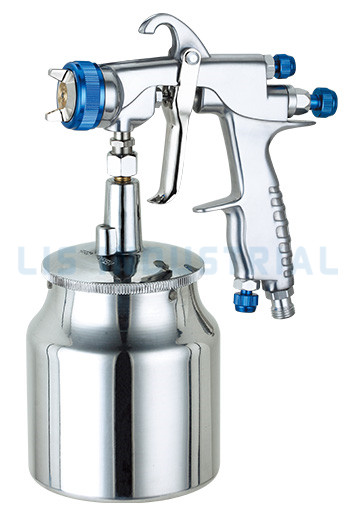
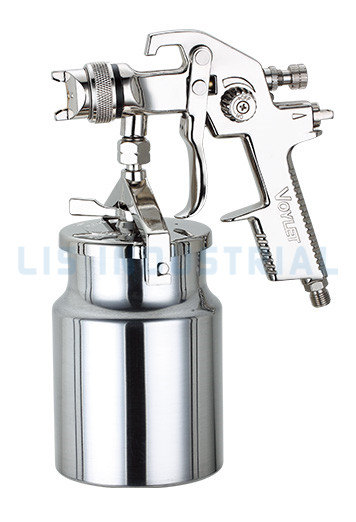
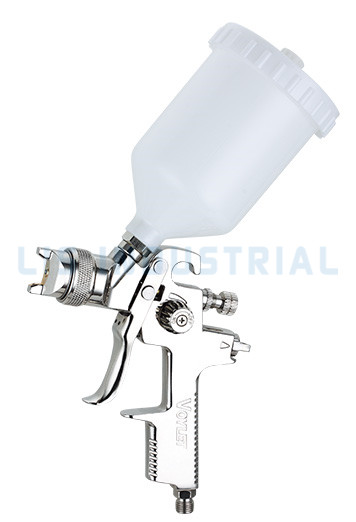
Most modern HVLP spray guns use a gravity feed cup mounted on top of the gun body, which relies on gravity to move coating material down into the airstream rather than relying on suction created by the airflow. This design generally supports more consistent atomization at low pressure and tends to leave less unused material in the cup at the end of a job compared with older suction feed designs, which is another contributing factor to lower overall material waste.
Why Lower Pressure Atomization Cuts Overspray And Paint Waste
Paint waste in spray finishing comes from three main sources: material that bounces off the surface and falls to the floor, material that becomes airborne and is pulled into the exhaust or ventilation system, and material left unused in the cup, hose, or gun passages after the job is finished. An HVLP spray gun addresses the first two sources directly because its slower moving, higher volume air pattern carries less kinetic energy on impact, so more droplets settle onto the surface instead of rebounding.
The Relationship Between Transfer Efficiency And Waste
Transfer efficiency describes the percentage of sprayed material that actually ends up on the target surface rather than lost to overspray. If a conventional gun achieves 30 percent transfer efficiency, then 70 percent of the material sprayed never makes it onto the part. If an HVLP spray gun raises that figure to 65 percent, the amount of wasted material is cut by more than half for the same coating job, which is why many finishing operations report a meaningful reduction in coating consumption after switching to low pressure atomization equipment.
Fan Pattern Control And Its Role In Reducing Waste
Adjustable fan pattern and fluid control knobs on most HVLP spray guns allow the operator to match the spray width and material output to the size of the part being coated. A narrow fan pattern used correctly on small parts or edges avoids sending excess material past the edges of the workpiece, while a wider pattern suits large flat panels. Proper fan pattern adjustment, paired with correct gun distance and travel speed, further supports the waste reduction that low pressure atomization already provides.
HVLP Spray Gun Compared With Conventional Spray Gun
The table below summarizes the main operating differences that influence paint consumption and finish quality between the two spray gun categories.
| General comparison between HVLP and conventional spray gun operating characteristics | ||
| Comparison Point | HVLP Spray Gun | Conventional Spray Gun |
| Typical air cap pressure | Around 10 psi | 40 psi and above |
| Typical transfer efficiency | 65 to 70 percent | 30 to 35 percent |
| Overspray level | Lower | Higher |
| Air volume requirement | Higher volume, lower pressure | Lower volume, higher pressure |
| Suitable coating viscosity | Light to medium viscosity coatings | Wide viscosity range including heavier coatings |
| Common cup style | Gravity feed | Suction feed or pressure feed |
| Typical finish appearance | Fine, controlled finish | Can vary with pressure setting |
Paint Waste Reduction Trend Across Air Pressure Settings
Lowering atomizing pressure does not always reduce waste in a straight line, since pressure that is set too low can affect atomization quality and finish appearance. The chart below shows a general trend of estimated paint waste reduction as air cap pressure decreases from a high pressure conventional setting down toward the low pressure range typical of an HVLP spray gun.
Where Paint Savings Show Up Across Different Finishing Industries
An HVLP spray gun is used across a wide range of coating tasks, and the practical amount of paint savings reported tends to vary by industry due to part geometry, coating type, and typical booth setup. The chart below reflects a general estimate of where noticeable savings are most often reported.
Side By Side Performance Radar Overview
Beyond a single waste reduction figure, several performance traits together shape how well an HVLP spray gun fits a given job. The simplified radar view below compares HVLP technology against conventional spray guns across finish quality, waste control, air efficiency, versatility, and ease of use.
Choosing The Right Nozzle And Cup Setup For Lower Waste
Nozzle size, sometimes called the fluid tip size, has a direct effect on how much material leaves the gun per pass and how well that material atomizes at low pressure. A tip that is too large for the coating viscosity can flood the surface and increase runs, while a tip that is too small may force the operator to make extra passes, both of which add unnecessary material use.
Matching Tip Size To Coating Viscosity
Lighter coatings such as thin lacquers and stains generally pair well with a smaller fluid tip, while medium bodied coatings such as many enamels and primers often call for a mid range tip size. Checking the coating manufacturer guidance alongside the spray gun manufacturer chart for recommended tip and pressure combinations helps keep atomization consistent, which in turn keeps waste closer to the lower end of the expected range.
Cup Capacity And Job Planning
Selecting a cup capacity that reasonably matches the size of the job reduces the amount of leftover coating that must be handled at cleanup. For small touch up work, a smaller cup limits the volume of mixed material exposed to air, while larger cups suit continuous production runs where refilling mid job would slow the process.
Key Factors That Influence Spray Gun Performance And Waste Levels
Even a well designed HVLP spray gun depends on correct setup and technique to reach its expected waste reduction potential. The following factors are commonly checked during spray finishing training and equipment setup.
- Confirm air cap pressure matches the gun manufacturer recommendation using a test gauge at the cap
- Keep gun distance from the surface within the recommended range, generally around 6 to 8 inches for many gravity feed guns
- Maintain consistent, even travel speed and keep the gun perpendicular to the surface
- Adjust fan pattern width to suit the size of the part or panel section being coated
- Use coating viscosity within the range suited to the installed fluid tip
- Check air supply volume and filtration to avoid moisture or contamination affecting atomization
Maintenance Habits That Keep An HVLP Spray Gun Performing Efficiently
Consistent transfer efficiency depends on keeping the air cap, fluid tip, and needle assembly clean and free of dried coating buildup, since even small deposits can distort the spray pattern and push transfer efficiency back down toward conventional levels.
- Clean the air cap and fluid tip after every color or coating change
- Soak or rinse removable parts according to the coating type being used
- Inspect seals and gaskets periodically for wear that could cause leaking
- Store the gun with the cup empty and cleaned to avoid dried residue buildup
- Replace worn nozzles and needles when spray pattern becomes uneven
- Check air hose connections regularly for leaks that reduce delivered air volume
Manufacturing Behind Reliable Custom And OEM HVLP Spray Guns
Ningbo Lis Industrial Co., Ltd has worked in air and pneumatic spray finishing equipment since 1984, developing experience as a China HVLP spray gun factory serving customers across furniture, automotive refinishing, and general industrial coating applications. As a professional paint spray gun manufacturer and industrial spray gun supplier, Lis maintains an in house research and development team that supports both standard product lines and custom HVLP spray gun projects built from customer drawings or samples, alongside ODM and OEM HVLP spray gun development for brands building their own product range. The company also serves as an HVLP spray gun distributor and wholesale HVLP spray gun partner for businesses seeking bulk HVLP spray gun supply arrangements, with a marketing and service network reaching customers across Europe, North America, the Middle East, South Africa, and East Asia. Whether the requirement is a standard gravity feed HVLP spray gun or a fully customized configuration, working with an established HVLP spray gun manufacturer and HVLP spray gun supplier helps ensure the equipment is matched correctly to the intended coating, air supply, and finishing environment.
Frequently Asked Questions
Q1: Is HVLP better than conventional spray guns?HVLP technology generally offers higher transfer efficiency and lower overspray than conventional spray guns, which suits work where material savings and finish control matter, though conventional guns remain suited to some heavier coating tasks. |
Q2: What pressure should an HVLP spray gun beMost gravity feed HVLP spray guns are designed to run around 10 psi measured at the air cap, though the exact setting should follow the specific gun manufacturer instructions and coating being used. |
Q3: Can HVLP spray stainYes, HVLP spray guns are commonly used for thin viscosity coatings such as stains, provided the fluid tip size and pressure setting match the thinner material to avoid over application. |
Q4: Can HVLP spray enamelHVLP spray guns can apply many enamel coatings when paired with a suitable medium size fluid tip and correct thinning ratio according to the coating manufacturer guidance. |
Q5: Why is my spray gun leakingLeaking is often caused by worn seals, a loose needle packing nut, or a damaged fluid tip seat, and checking these components typically resolves the issue. |
Q6: Why is my spray gun spittingSpitting is commonly linked to a loose or damaged air cap, low material level in the cup, or a partially clogged fluid passage, and cleaning or tightening these areas usually helps. |
Q7: How do you clean an HVLP spray gunDisassemble the air cap, fluid tip, and needle after use, rinse or soak the parts in a solvent suited to the coating type, and wipe down the gun body before reassembly. |
Q8: How often should you replace the nozzleNozzle replacement depends on usage frequency and coating abrasiveness, and is generally recommended once the spray pattern becomes uneven or inconsistent despite thorough cleaning. |