 Search

 English
 中文简体
 Deutsch
 Español
Content
- 1 The Five Working Groups at a Glance
- 2 Air Cap and Nozzle Set: Where the Pattern Is Made
- 3 The Fluid Section: Needle, Nozzle Seat and Fluid Passage
- 4 Air Inlet, Air Valve and Regulator: the Supply End
- 5 Trigger, Fluid Adjustment and Pattern Control
- 6 Springs, Seals and Gaskets: the Cheap Parts That Stop a Gun
- 7 Materials and Tolerances: Reading a Spec Sheet
- 8 Matching Symptoms to Parts
- 9 Frequently Asked Questions
- 9.1 Q1. What are the main parts of a paint spray gun?
- 9.2 Q2. How do I know if I need a new nozzle and needle set?
- 9.3 Q3. Can I replace just the needle without replacing the nozzle?
- 9.4 Q4. What size nozzle do I need for car painting?
- 9.5 Q5. Why is my HVLP spray gun spitting paint?
- 9.6 Q6. Where can I buy replacement parts for a paint spray gun?
A paint spray gun looks like one solid tool, but it is really five working groups stacked together: the air supply end, the air cap and nozzle set, the fluid needle and fluid passage, the trigger and adjustment controls, and the body with its seals and springs. Know which group does what, and most "the gun is broken" problems become diagnosable in a few minutes instead of a trip to the dealer.
The same architecture appears in gravity, suction and pressure feed guns, in HVLP and LVLP designs, and even in airless units that simply swap compressed air for a high-pressure pump. What changes between them is the supply method, the materials and the tolerances held on each part. What stays the same is the sequence: air is shaped, fluid is metered, and the two meet at the nozzle.
Quick answer: air cap, fluid nozzle (tip), fluid needle, air valve and inlet, trigger and adjustment knobs, plus the body, gaskets, springs and packing that hold them together. Needle and nozzle are a matched pair and should be replaced as a set.
The Five Working Groups at a Glance
Sorting the parts by function is more useful than memorising a diagram. Every component on a typical gun belongs to one of five groups, and each group announces its own wear in a recognisable way.
| Working group | Main parts | What it does | First sign of trouble |
| Air supply end | Air inlet nipple, air valve, filter-regulator, hose adapter | Delivers clean, dry, regulated air at a steady pressure | Pressure creeps down under load, or oil and water reach the nozzle |
| Atomising set | Air cap, fluid nozzle (tip), fluid needle | Meters paint and breaks it into a controlled fan | Uneven fan, spitting, or a heavy band of paint in the centre |
| Fluid path | Fluid passage, cup, siphon tube or pressure tank, packing gland | Moves paint from the container to the nozzle seat | Bubbles in the cup, paint weeping at the packing, pulsating flow |
| Control group | Trigger, fluid adjustment knob, pattern (fan) knob | Lets the operator start, stop, and shape the spray | Gritty or sticking trigger, adjustments that no longer change anything |
| Body and seals | Gun body, gaskets, O-rings, springs, retaining ring | Keeps every part aligned and leak-free | Paint weeping at joints or air leaking past the valve |
Air Cap and Nozzle Set: Where the Pattern Is Made
Three parts do the actual spraying, and they only work as a set. The fluid nozzle, often called the fluid tip, meters how much paint leaves the gun. The fluid needle seals against the nozzle seat when the trigger is released. The air cap sits at the very front and turns compressed air into the shape you see on the test panel.
Inside the air cap there are usually two kinds of holes. A centre hole blows atomising air straight into the fluid stream, while two horns on the sides blow fan air that flattens the round spray into an oval. Rotate the cap ninety degrees and the fan rotates with it, which is why painters turn the cap sideways when spraying a horizontal surface.
This is also where most pattern complaints originate. A heavy band of paint in the middle usually means atomising pressure is too low or the centre hole is partly blocked. A split or dumbbell pattern usually means air pressure is too high for the fluid tip fitted. A pulsing, spitting spray points to the needle, nozzle seat or packing rather than the air cap.
Guns built around low-pressure atomisation, such as HVLP spray guns, keep the same three-part front end but move a larger volume of air at lower pressure. Nozzle and needle sizing therefore matters more, not less: a 1.4 mm tip that behaves well at 3 bar on a conventional gun may need a different air cap on an HVLP unit.
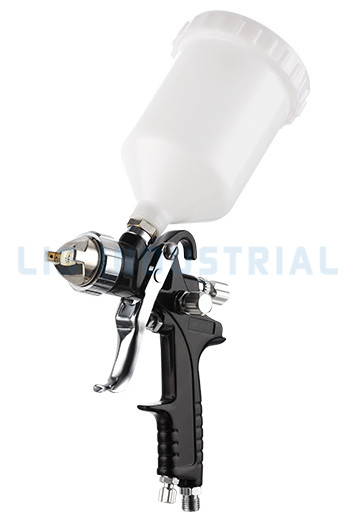
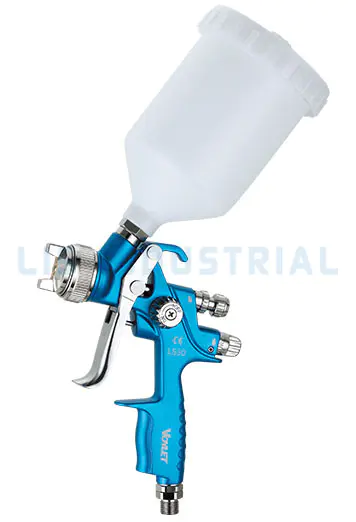
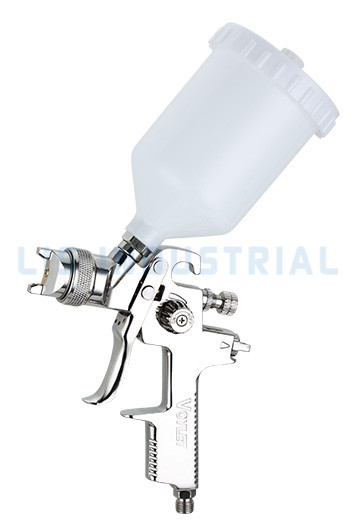
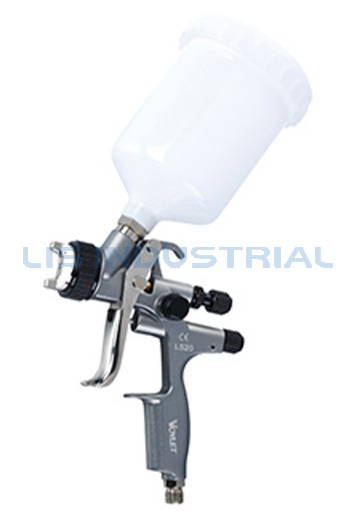 LS20 HVLP Gravity-Feed Spray Gun for Top-Coat ApplicationsGravity-feed HVLP gun with 1.3/1.7 mm nozzles and a 600 ml cup, suited to automotive, plastic, metal, and woodwork top-coat spraying.View Product →
The Fluid Section: Needle, Nozzle Seat and Fluid Passage
From the container to the nozzle seat, paint travels through a drilled fluid passage in the gun body. On a gravity gun the cup sits on top and paint falls into the passage; on a suction gun a siphon tube lifts it from a can below; on a pressure gun an external tank pushes it through a hose. The passage is the part most often neglected during cleaning, because a brush never reaches the corners and dried pigment quietly narrows the bore.
Needle and nozzle are a matched pair. The needle taper and the nozzle seat angle are ground to fit one another, and on better guns they are lapped together before assembly. Fitting a new needle into a worn nozzle almost always produces a drip or a sputter, because the seat is where the sealing actually happens, not the shaft.
Which feed method you have changes the parts list more than it changes the principle. Compare gravity feed spray guns with a suction model and you will still find the same needle, seat, packing and passage arrangement, plus a cup vent or siphon tube that has to stay clear for smooth flow.
Behind the needle sits the packing or gland seal. If paint weeps around the needle or the fluid adjustment knob, this is the part to replace, together with the needle spring. Buying a complete nozzle and needle kit plus a seal set is usually cheaper than troubleshooting one worn part at a time.
 AK2 Spray Gun Kit with Washing, Inflating, and Dust GunsMulti-piece AK2 kit bundles a spray gun, washing gun, inflating gun, air dust gun, and air hose for wholesale supply.View Product →
Air Inlet, Air Valve and Regulator: the Supply End
The air inlet is typically a quarter-inch BSP or NPT female thread at the bottom of the grip. Inside the body sits the air valve, a small piston or spool that opens when the trigger is pulled and closes when it is released. A worn valve seat or O-ring shows up as air escaping continuously from the inlet, or as a gun that keeps spraying after the trigger is let go.
The regulator and filter are not strictly part of the gun, but they decide how the gun behaves. Pressure should always be set with the trigger pulled and air flowing, because a static reading is higher than the working pressure. Dirty or wet air reaches the nozzle as water spots and fisheyes long before it damages any metal part, so a filter-regulator on the bench or wall is cheaper than repainting a panel.
 AFR80 Filter Regulator for Air Pipeline AccessoriesAir pipeline filter/regulator offering 10–120 PSI adjustment, 40μ filtration, and G1/4, G3/8, or G1/2 inlet choices.View Product →
Trigger, Fluid Adjustment and Pattern Control
The trigger group is small but it is the part operators touch most. A pivot pin, a plunger and one or two return springs transfer finger pressure to the fluid needle. Dried paint on the pin is the usual cause of a trigger that feels gritty or sticks halfway.
Two knobs shape the result. The fluid adjustment knob at the rear limits how far the needle can travel, and therefore how much paint can flow. A common mistake is opening it wide and then fighting the pattern; set it to the smallest opening that still gives a full fan at your working pressure. The pattern knob, also called the fan adjustment, controls air to the horns on the air cap and therefore the width of the fan.
Springs, Seals and Gaskets: the Cheap Parts That Stop a Gun
Solvent-resistant seals are the least glamorous parts of a spray gun and the ones that end a working day. PTFE and fluoroelastomer packing resist most solvents; nitrile is fine for waterborne coatings but swells with aggressive thinners. Cup gaskets, retaining rings and check valves on suction guns belong to the same category: a two-dollar part can imitate a two-hundred-dollar fault.
Materials and Tolerances: Reading a Spec Sheet
Two guns can look identical and behave nothing alike, because the difference sits in material choice and in tolerances measured in hundredths of a millimetre. A nozzle seat that is out of round by a few microns will drip no matter how carefully the gun is cleaned.
| Part | Common materials | What it decides | Signal of a better grade |
| Fluid nozzle and needle | Hardened stainless steel, brass on economy guns | Seat life with abrasive or metallic pigments | Stainless seat listed in the specification, replaceable as a matched set |
| Gun body | Die-cast aluminium, anodised; sometimes brass | Weight, corrosion resistance with waterborne coatings | Anodised or coated bore, no machining burrs in the fluid passage |
| Air cap | Nickel-plated brass or stainless steel | Accuracy of horn holes and atomisation quality | Clean, equal holes and a size marking stamped on the cap |
| Seals and packing | PTFE, fluoroelastomer, nitrile | Resistance to thinners and to waterborne formulas | Solvent list published and spare seal kits kept in stock |
| Springs and pins | Stainless spring steel | Trigger feel and long-term corrosion | Trigger returns fully and smoothly after thousands of cycles |
Manufacturers who follow a documented quality system, such as the ISO 9000 framework used by established spray gun makers, apply incoming inspection, in-process checks and full functional testing before packing. That matters to a buyer because a needle that has been lapped to its nozzle in the factory cannot be reproduced reliably by mixing parts from two different production batches.
Matching Symptoms to Parts
With the groups in mind, diagnosis becomes a short checklist rather than a guessing game. Start from the symptom, not from the part you suspect.
| Symptom | Check first | What to look for |
|---|---|---|
| Paint drips from the nozzle at rest | Fluid needle and nozzle seat | Debris on the seat, a worn taper, or a weak needle spring |
| Spitting or pulsating spray | Fluid passage, packing, cup vent | Partly blocked passage, loose air cap, blocked vent hole in the cup lid |
| Heavy band in the centre of the fan | Air cap centre hole and atomising pressure | Clogged centre hole, pressure below the specification, tip too small |
| Split or dumbbell pattern | Air cap horns and pressure | Pressure too high, blocked or damaged horn holes, wrong cap for the tip |
| Trigger sticking or not returning | Trigger pin, plunger, springs | Dried paint on the pin, a bent plunger, a corroded return spring |
| Air escaping from the inlet continuously | Air valve | A worn valve seat or a hardened valve O-ring |
Frequently Asked Questions
Q1. What are the main parts of a paint spray gun?
The main parts are the air cap, the fluid nozzle and fluid needle, the air inlet and air valve, the trigger and adjustment knobs, and the body with its gaskets, springs and packing. The needle and nozzle form a matched set and should be replaced together.
Q2. How do I know if I need a new nozzle and needle set?
If the fan is uneven after cleaning, if paint drips from the tip when the trigger is released, or if the pattern changes between passes at the same pressure, the seat is usually worn. Compare the spray against a new matched set before replacing anything else.
Q3. Can I replace just the needle without replacing the nozzle?
You can, but it rarely seals properly. The seat angle and the needle taper are lapped to each other, so a new needle against a worn seat still drips. Buying a complete needle and nozzle kit is the reliable option.
Q4. What size nozzle do I need for car painting?
Automotive basecoats and clearcoats generally sit around 1.2 to 1.5 mm, while primers and fillers run larger at roughly 1.6 to 1.8 mm. Always confirm against the gun maker's data sheet, because air cap design changes the ideal size.
Q5. Why is my HVLP spray gun spitting paint?
Spitting is almost always a fluid-side problem: a partly blocked passage, dried paint on the needle seat, a loose packing gland, or a blocked vent in the cup lid. Check the fluid path before touching the air cap or pressure setting.
Q6. Where can I buy replacement parts for a paint spray gun?
Buy from the manufacturer or an authorised distributor so the nozzle, needle and air cap are dimensionally matched to your model. Makers such as LIS publish parts lists and seal kits, which is the safest route for professional and wholesale users.