 Search
 English
 中文简体
中文简体 Deutsch
 Español
Content
- 1 The Physics Behind HVLP Transfer Efficiency
- 2 Gravity Feed vs. Suction Feed: Why Gravity Wins for Efficiency
- 3 Key Components That Drive HVLP Performance
- 4 How Transfer Efficiency Improves with Proper Technique
- 5 Setting Up Your HVLP Spray Gun for Maximum Efficiency
- 6 Regulatory and Environmental Advantages of HVLP Technology
- 7 Cleaning and Maintenance for Consistent Performance
- 8 Choosing the Right HVLP Spray Gun for Your Industry
- 9 Frequently Asked Questions
- 10 About NINGBO LIS INDUSTRIAL CO., LTD.
HVLP spray guns increase coating transfer efficiency by 30% or more compared to conventional high-pressure systems—primarily by reducing atomization air pressure at the cap to 10 PSI or below, which dramatically cuts overspray and keeps more coating on the target surface. The result is less material waste, lower VOC emissions, and faster production cycles. This article breaks down exactly how that efficiency gain works, how to maximize it in practice, and what to look for when selecting a gravity feed high volume low pressure spray gun for your application.
The Physics Behind HVLP Transfer Efficiency
Transfer efficiency (TE) measures the percentage of coating material that actually lands on and adheres to the workpiece. Conventional spray guns operating at 40–60 PSI at the cap generate high-velocity atomized particles that bounce off surfaces, drift with air currents, and create substantial overspray clouds. A standard conventional gun typically achieves 25–40% TE.
An HVLP spray gun moves a high volume of air at low pressure—typically 15–26 CFM at 45 PSI inlet, reduced to under 10 PSI at the air cap. Lower exit velocity means atomized droplets travel more slowly, penetrate turbulence less aggressively, and settle onto the surface rather than bouncing off or drifting away. Independent testing across automotive, woodworking, and industrial finishing sectors consistently shows HVLP TE values between 65% and 85%—a genuine 30–45 percentage point improvement.
For every 10 liters of coating used, a conventional gun wastes 6–7.5 liters to overspray. The same job with an HVLP spray gun wastes only 1.5–3.5 liters. On a production line consuming 200 liters per week, that translates to 50–100 liters of material saved weekly—directly reducing costs and environmental impact.
Gravity Feed vs. Suction Feed: Why Gravity Wins for Efficiency
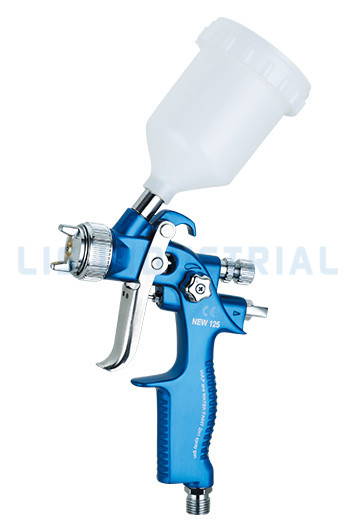
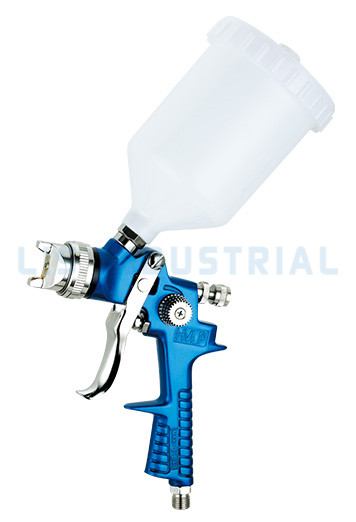
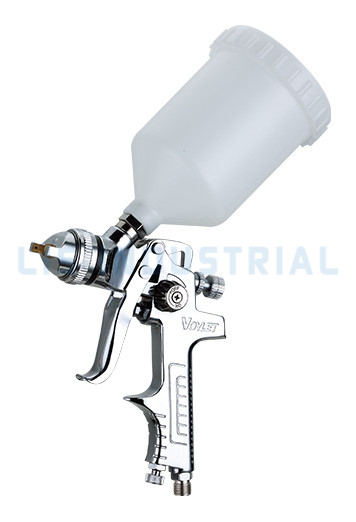
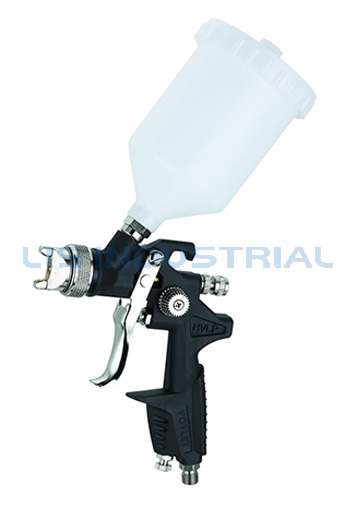
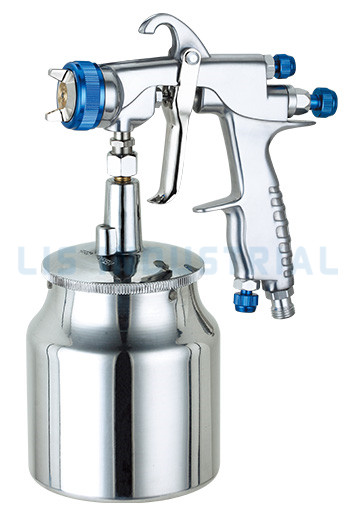
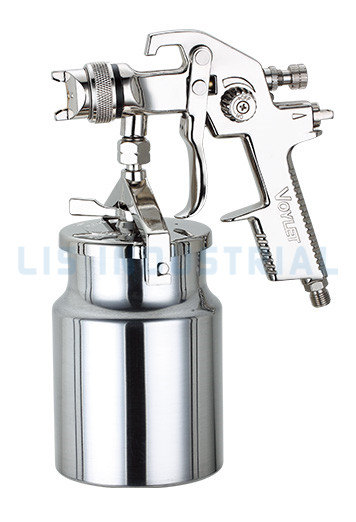
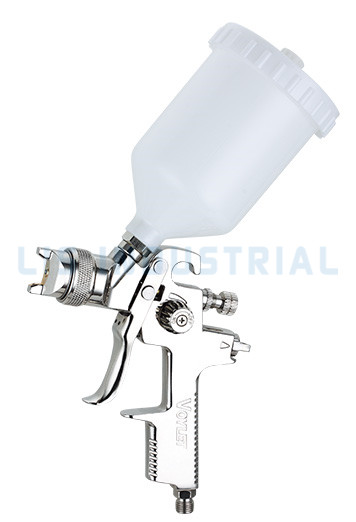
Most professional HVLP spray guns today are gravity feed designs—and for good reason. In a gravity feed high volume low pressure spray gun, the fluid cup sits on top of the gun body. Gravity assists material flow into the fluid passage, which means the gun needs less air pressure to draw and atomize the coating.
| Table 1: Transfer efficiency and performance comparison across spray gun types | |||
| Feature | Gravity Feed HVLP | Suction Feed HVLP | Conventional Pressure |
| Transfer Efficiency | 70–85% | 60–75% | 25–40% |
| Air Cap Pressure | <10 PSI | <10 PSI | 40–60 PSI |
| Material Waste | Low | Low–Medium | High |
| Residual Material in Cup | Minimal (<5 ml) | 10–30 ml | Varies |
| Best Application | Automotive, fine finishing | Large surface coverage | Heavy industrial |
The gravity feed design also leaves less residual coating in the cup at the end of a job—important when spraying expensive materials like high-solid clears or specialty primers. Less residual means less waste per job cycle.
Key Components That Drive HVLP Performance
Air Cap Design
The air cap is the single most critical component in any HVLP spray gun. It controls fan pattern width, atomization quality, and cap pressure. A well-engineered air cap uses precisely sized center and side-port holes to balance air volume and velocity. Fan width typically ranges from 150mm to 300mm depending on cap selection. Choosing the right cap for your coating viscosity and substrate size is as important as choosing the right gun body.
Fluid Needle and Nozzle
The fluid needle and nozzle set determines flow rate and is matched to coating viscosity. Common sizes include 1.3mm, 1.4mm, and 1.7mm for automotive and industrial applications. Using a nozzle that is too large for a thin coating produces runs and orange peel; too small for a thick coating causes spitting and uneven delivery. Always match the nozzle to the manufacturer's viscosity chart.
Fluid Cup Capacity and Material
Gravity feed cups on HVLP spray guns typically range from 125 ml to 600 ml. Smaller cups reduce arm fatigue during overhead work; larger cups reduce refill frequency on long production runs. High-quality cups use solvent-resistant materials and precise lid seals to prevent leakage and evaporation of volatile components.
How Transfer Efficiency Improves with Proper Technique
Even the best gravity feed high volume low pressure spray gun delivers poor results with incorrect technique. These five practices have the greatest measurable impact on transfer efficiency:
- Gun distance: Hold the gun 15–20 cm from the surface. Moving closer increases material buildup and runs; moving further increases overspray and dry spray particles. Every 5 cm beyond the optimal range reduces TE by approximately 5–8%.
- Gun speed: Move at a consistent 30–45 cm per second. Slowing down causes flooding; speeding up causes thin, uneven coats that require additional passes.
- Overlap: Maintain 50% overlap between each pass. Less overlap creates stripes; more overlap wastes material and creates thick edges.
- Trigger control: Release the trigger at the end of each pass before reversing direction. Continuing to spray during the turn deposits excess material on the edges.
- Viscosity management: Always reduce coatings to the manufacturer's recommended spray viscosity—typically 16–25 seconds in a DIN 4 cup for most waterborne and solventborne topcoats.
Transfer Efficiency (%) by Gun Type and Technique Level
Figure 1: Transfer efficiency varies significantly by both gun type and operator technique
Setting Up Your HVLP Spray Gun for Maximum Efficiency
Correct setup before spraying is where most efficiency gains are either captured or lost. Follow this sequence every time:
- Set inlet pressure correctly. Most HVLP spray guns require 29–45 PSI at the gun inlet (not at the compressor regulator). Use an inline gauge at the gun handle for accuracy. Inlet pressure set at the regulator alone is typically 5–10 PSI higher than actual gun inlet pressure due to hose friction loss.
- Verify air cap pressure. Use an air cap test kit to confirm the cap delivers under 10 PSI—the regulatory threshold in most jurisdictions for HVLP classification (SCAQMD Rule 1151, EU equivalent standards).
- Adjust fan and fluid controls. Open the fan control fully, then reduce the fluid needle to match the coating flow rate needed. Fine-tune the fan width to suit the workpiece size.
- Conduct a test spray on cardboard. Check for even fan distribution, correct atomization (no large droplets at edges), and consistent wetness across the pattern before spraying the actual part.
- Filter the air supply. Use a water/oil separator immediately upstream of the gun. Oil contamination from an unfiltered compressor causes fish-eye defects and immediate adhesion failure.
Regulatory and Environmental Advantages of HVLP Technology
In many regions, HVLP spray guns are not just preferred—they are legally required for certain coating operations. California's SCAQMD Rule 1151, for example, mandates minimum 65% TE for automotive refinishing. The European Union's Industrial Emissions Directive similarly restricts overspray and VOC emissions in commercial painting operations.
Beyond compliance, the environmental math is compelling. Reducing overspray by 30–40% directly reduces VOC emissions proportionally—significant for facilities operating under emission caps. A shop spraying 500 liters of solventborne coating per month could reduce VOC output by 150–200 liters of solvent equivalent simply by switching from conventional to HVLP equipment.
VOC Emission Reduction Over 12 Months After Switching to HVLP (kg/month)
Figure 2: Typical VOC emission trajectory after transitioning to HVLP spray gun equipment (illustrative facility data)
Cleaning and Maintenance for Consistent Performance
A poorly maintained HVLP spray gun loses efficiency rapidly. Dried coating in the air passages raises air cap pressure beyond the 10 PSI threshold, instantly negating the HVLP advantage. Follow this cleaning protocol after every use:
- Empty remaining coating from the cup and spray solvent through the gun until fluid runs clear.
- Disassemble the fluid needle, nozzle, and air cap. Soak in appropriate solvent for 10–15 minutes.
- Clean air cap holes with a soft bristle brush only—never use wire or metal tools, which enlarge holes and permanently alter atomization characteristics.
- Inspect the fluid needle tip for wear or scoring. A worn needle is the most common cause of dripping between passes.
- Lubricate the needle packing with a small amount of petroleum jelly or gun lube before reassembly to maintain smooth trigger action.
- Store the gun with the fluid needle slightly open (trigger pulled a fraction) to prevent the packing from compressing and hardening around the needle.
Guns that receive proper cleaning after every session maintain consistent atomization quality for 3 to 5 years of daily use. Neglected guns may need nozzle or air cap replacement within months.
Choosing the Right HVLP Spray Gun for Your Industry
Not all HVLP spray guns are built for the same tasks. The gravity feed high volume low pressure spray gun platform spans a wide range of applications. Use this guide to match gun specification to application:
| Table 1: Transfer efficiency and performance comparison across spray gun types | |||
| Feature | Gravity Feed HVLP | Suction Feed HVLP | Conventional Pressure |
| Transfer Efficiency | 70–85% | 60–75% | 25–40% |
| Air Cap Pressure | <10 PSI | <10 PSI | 40–60 PSI |
| Material Waste | Low | Low–Medium | High |
| Residual Material in Cup | Minimal (<5 ml) | 10–30 ml | Varies |
| Best Application | Automotive, fine finishing | Large surface coverage | Heavy industrial |
Frequently Asked Questions
About NINGBO LIS INDUSTRIAL CO., LTD.
Ningbo Lis Industrial Co., Ltd. is an advanced China HVLP Spray Gun Manufacturers and HVLP Gravity Feed Spray Gun factory. Our products have earned CE, GS, and other internationally recognized certifications, reflecting our commitment to quality, safety, and reliability across global markets.
At Lis, product quality is the foundation of everything. We maintain a strong R&D team capable of delivering OEM services based on customer drawings or samples, as well as comprehensive ODM solutions tailored to specific application requirements. This flexibility allows us to serve diverse industries with precision-engineered spray equipment.
CE & GS
International certifications
5 Regions
Europe, N. America, Middle East, S. Africa, East Asia
OEM & ODM
Fully customizable spray solutions
Lis has established a worldwide marketing and service network, with products widely sold across Europe, North America, the Middle East, South Africa, and East Asia. We have developed strong, lasting business relationships in each of these regions through consistent product performance and responsive technical support.
Our air and pneumatic HVLP spray gun range is fully customizable to meet client specifications. Whether you require a specific nozzle configuration, body material, or coil voltage, Lis delivers engineered solutions that align precisely with your production needs. As your trusted partner in spray finishing technology, Lis combines manufacturing depth with global reach to keep your operations running at peak efficiency.