 Search
 English
 中文简体
中文简体 Deutsch
 Español
Content
- 1 HVLP Spray Guns Are More Efficient at Material Transfer, but Airless Sprayers Are More Efficient at Coverage Speed
- 2 How HVLP Spray Guns Work and Why Transfer Efficiency Is High
- 3 How Airless Sprayers Work and Why They Excel at Speed
- 4 Comprehensive Side-by-Side Comparison
- 5 Material Cost Savings: Where HVLP's Transfer Efficiency Advantage Becomes Financial
- 6 Finish Quality: Why HVLP Produces Superior Results on Precision Work
- 7 When Airless Sprayers Are the More Practical Choice
- 8 HVLP vs. HVLP Turbine vs. Compressor-Fed HVLP: Understanding the Variants
- 9 Frequently Asked Questions About HVLP Spray Guns
- 9.1 Do I need to thin paint to use an HVLP spray gun?
- 9.2 What compressor size do I need to run an HVLP spray gun?
- 9.3 Can an HVLP spray gun be used for automotive painting?
- 9.4 How do I clean an HVLP spray gun after use?
- 9.5 What is the difference between HVLP and LVLP spray guns?
- 9.6 How much does a quality HVLP spray gun cost, and is it worth the investment over a cheap gun?
HVLP Spray Guns Are More Efficient at Material Transfer, but Airless Sprayers Are More Efficient at Coverage Speed
HVLP spray guns achieve transfer efficiency rates of 65–90% — meaning 65–90% of the coating material actually lands on the target surface. Airless sprayers typically achieve only 40–65% transfer efficiency due to higher atomization pressures that generate significant overspray and rebound. However, airless sprayers can cover large surfaces 5–10 times faster than HVLP guns and handle thicker coatings without thinning. The correct answer to which is "more efficient" depends entirely on what you are measuring: if efficiency means material utilization and finish quality, HVLP wins decisively. If efficiency means square footage covered per hour on large commercial jobs, airless sprayers dominate. Most professional finishers use both tools — HVLP for detail work and finish coats, airless for primer and large-area coverage.
How HVLP Spray Guns Work and Why Transfer Efficiency Is High
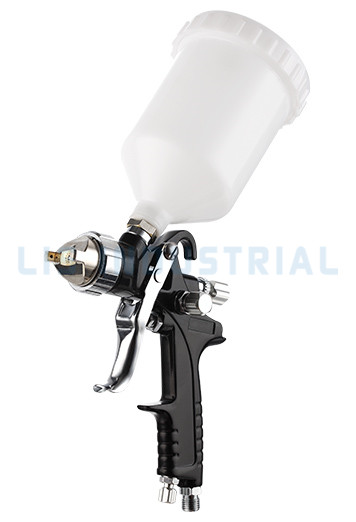
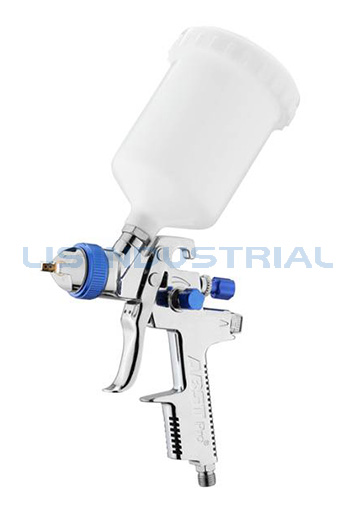
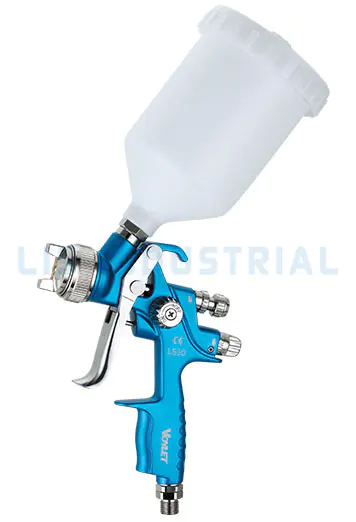
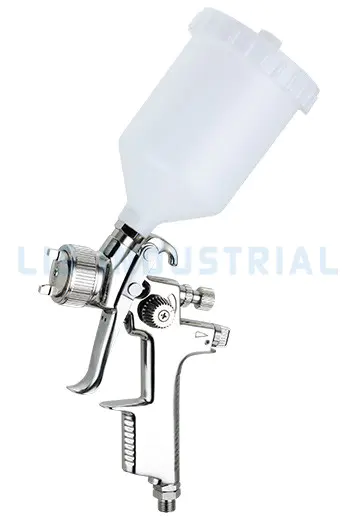
HVLP stands for High Volume Low Pressure. The technology was developed specifically to address the waste and overspray problems of conventional high-pressure spray guns, which were being regulated out of use in California and other jurisdictions due to VOC emissions from overspray.
The Operating Principle
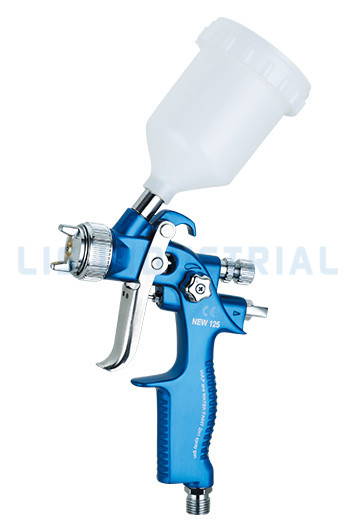
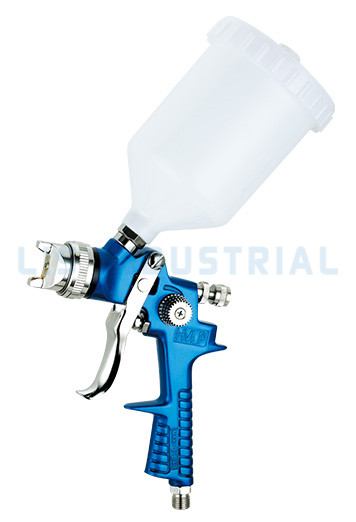
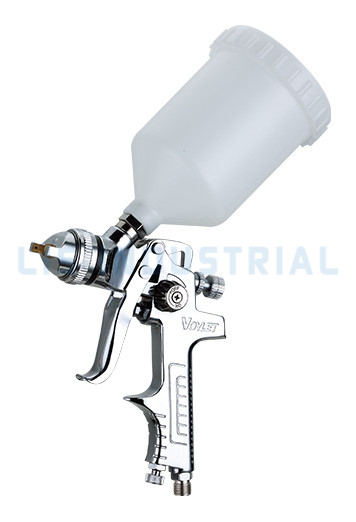
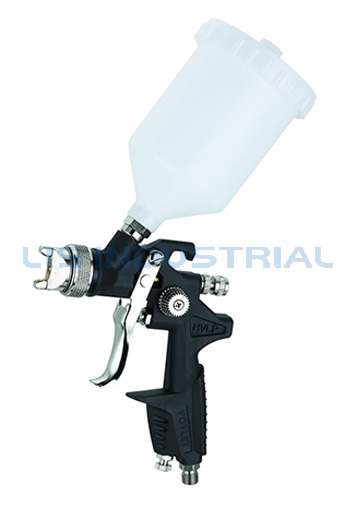
An HVLP spray gun atomizes coating material using a high volume of air at low pressure — typically 0.1–1.0 bar (1.5–15 PSI) at the air cap, compared to 1.5–4.0 bar (20–60 PSI) for conventional spray guns. The high air volume (measured in CFM — cubic feet per minute) creates sufficient turbulence to break the liquid coating into fine droplets, while the low pressure means those droplets travel slowly and gently toward the surface rather than being blasted at high velocity.
This low-velocity delivery is the key to high transfer efficiency. High-pressure spray produces fast-moving droplets that bounce off or rebound from the target surface, becoming overspray. Slow-moving HVLP droplets decelerate and land on the surface more reliably. The result is less wasted material, less airborne contamination, and better regulatory compliance — most jurisdictions that regulate spray finishing require transfer efficiency of at least 65%, which HVLP meets easily.
Air Supply Requirements
HVLP guns require a substantial air supply — typically 8–15 CFM (225–425 L/min) at the compressor, which is more than most small shop compressors can sustain continuously. Professional HVLP systems use either large compressors (minimum 5–7 HP) or dedicated turbine units that generate the required high-volume airflow at the correct low pressure without requiring a separate compressor and regulator setup.
How Airless Sprayers Work and Why They Excel at Speed
Airless sprayers operate on a fundamentally different principle from HVLP guns. They use a hydraulic pump — electric, pneumatic, or gas-powered — to pressurize the coating material directly to very high pressures, typically 100–300 bar (1,500–4,500 PSI). The pressurized fluid is forced through a small orifice in a hardened spray tip, where the sudden pressure drop atomizes the coating without any air involvement.
Why Airless Systems Cover More Area Faster
The high pressure in an airless system allows it to spray thick, high-viscosity coatings — latex house paint, heavy primers, elastomeric coatings, and industrial epoxies — without thinning. It also drives the coating into porous surfaces like concrete, masonry, and rough wood more effectively than HVLP. Airless tips are available with fan widths of 6–18 inches (15–46 cm), allowing a single pass to cover a wide strip. A professional airless sprayer can apply 15–30 gallons per hour, whereas an HVLP gun typically delivers 2–8 ounces per minute (roughly 1–4 gallons per hour) — a 5–10× speed disadvantage for large jobs.
The Overspray Trade-Off
The high pressures and velocities involved in airless spraying generate significant overspray — fine mist that travels beyond the target surface and settles on surrounding areas. On outdoor painting jobs where masking and overspray control are less critical, this is manageable. In enclosed spaces, automotive refinishing, or finish carpentry where contamination of adjacent surfaces is unacceptable, the overspray from airless sprayers creates serious practical problems that HVLP guns avoid.
Comprehensive Side-by-Side Comparison
| Performance comparison of HVLP spray guns versus airless sprayers across key operational parameters | ||
| Factor | HVLP Spray Gun | Airless Sprayer |
| Transfer Efficiency | 65–90% | 40–65% |
| Operating Pressure | 0.1–1.0 bar at air cap | 100–300 bar at fluid |
| Coverage Speed | 1–4 gallons/hour | 15–30 gallons/hour |
| Overspray Level | Low (10–35%) | High (35–60%) |
| Finish Quality | Excellent — fine atomization | Good — coarser atomization |
| Coating Viscosity Range | Low–medium (often requires thinning) | Low–high (handles thick coatings) |
| Equipment Cost | $50–$800 (gun); $300–$1,500 (turbine) | $200–$5,000+ (full system) |
| Best Application | Automotive, furniture, cabinetry, trim | Walls, ceilings, exteriors, large surfaces |
| Regulatory Compliance | Compliant in all VOC-regulated jurisdictions | May require additional controls in regulated areas |
Material Cost Savings: Where HVLP's Transfer Efficiency Advantage Becomes Financial
The transfer efficiency difference between HVLP and airless sprayers translates directly into material cost — one of the most significant operating expenses in any spray finishing operation.
Consider a practical example: a cabinet shop applying lacquer at $25 per gallon, using 100 gallons per month.
- With an airless sprayer at 55% transfer efficiency: 45% of material is wasted as overspray — 45 gallons wasted per month at $25 = $1,125/month in wasted material
- With an HVLP spray gun at 80% transfer efficiency: 20% wasted — 20 gallons wasted per month at $25 = $500/month in wasted material
- Monthly material saving: $625 — or $7,500 per year from material savings alone
For finishing operations using expensive automotive paints, specialty coatings, or two-component systems priced at $50–$200 per gallon, the material savings from switching to HVLP can be substantially higher and justify the investment in equipment within months.
Finish Quality: Why HVLP Produces Superior Results on Precision Work
For applications where finish quality is the primary criterion — automotive refinishing, furniture lacquering, kitchen cabinetry, musical instruments, and fine woodworking — HVLP spray guns consistently outperform airless sprayers for several measurable reasons.
Atomization Fineness
HVLP guns produce droplet sizes in the range of 30–80 microns, resulting in a fine, uniform wet film that levels well and produces a smooth, consistent surface. Airless sprayers produce larger, less uniform droplet sizes — typically 100–300 microns — that can produce a slightly textured or "orange peel" surface finish on smooth substrates, requiring additional sanding and finishing steps to achieve equivalent smoothness.
Control and Fan Pattern Adjustment
HVLP guns offer independent adjustment of fluid flow, air volume, and fan pattern shape, giving the operator precise control over how the coating is applied. This adjustability allows the operator to adapt quickly to different surface geometries, coating viscosities, and film thickness requirements. Airless sprayers are adjusted primarily by changing the spray tip (a slower, more disruptive process) and adjusting fluid pressure — a blunter set of controls that makes fine work less practical.
Reduced Bounce-Back on Contoured Surfaces
When spraying into recesses, corners, molding profiles, or curved surfaces, the low-velocity delivery of HVLP minimizes bounce-back — the phenomenon where high-pressure spray rebounds off the surface and deposits unevenly. This makes HVLP the strongly preferred choice for cabinetry doors with raised panels, chair legs, spindles, and any surface where geometry creates spray traps.
When Airless Sprayers Are the More Practical Choice
Despite HVLP's efficiency and finish quality advantages, there are specific applications where airless sprayers are clearly the better tool — and attempting to use HVLP would be impractical or economically irrational.
- Large exterior painting projects: A house painter covering 2,000+ square feet of siding per day cannot achieve that productivity with HVLP. An airless sprayer completes in hours what would take days with HVLP, and the slight overspray and finish texture difference is irrelevant on exterior surfaces viewed from a distance.
- High-viscosity coatings: Latex house paint, elastomeric roof coatings, thick epoxy primers, and intumescent fire-protective coatings are too viscous to spray through an HVLP system without heavy thinning — which can compromise coating performance. Airless systems handle these materials without thinning at pressures of 150–250 bar.
- Industrial and protective coatings: Heavy-duty corrosion protection coatings, zinc-rich primers, and other industrial coatings specified at film thicknesses of 75–300 microns (3–12 mils) DFT are applied most efficiently by airless spraying, which can build heavy film in fewer passes.
- Remote or off-grid locations: Gas-powered airless sprayers are self-contained and can operate anywhere, while HVLP systems require either a compressor or turbine unit with a reliable power source.
HVLP vs. HVLP Turbine vs. Compressor-Fed HVLP: Understanding the Variants
Not all HVLP spray gun systems are identical in performance. The air supply method significantly affects atomization quality, pressure consistency, and practical usability.
- Turbine HVLP: Uses a dedicated turbine unit (1–5 stages) that generates warm, dry, high-volume air directly — no separate compressor or air dryer needed. Turbine systems are self-contained and provide consistent atomization. Higher-stage turbines (3–5 stage) produce better atomization and handle thicker coatings. Cost ranges from $300 to $1,500 for the turbine unit.
- Compressor-fed HVLP (compliant guns): Uses a standard shop compressor with an HVLP-compliant gun designed to reduce air cap pressure to below 10 PSI. Requires a compressor capable of sustained 10–15 CFM output — most small compressors (under 5 HP) cannot meet this demand continuously. The advantage is using existing compressor infrastructure; the disadvantage is the requirement for moisture filtration and pressure regulation at the gun.
- HVLP conversion guns: Standard gravity-feed or pressure-feed guns converted to HVLP-compliant air caps. Transfer efficiency varies by design — true HVLP compliant guns achieve the 65%+ transfer efficiency threshold, while poorly designed conversion units may not meet regulatory standards despite being marketed as HVLP.
Frequently Asked Questions About HVLP Spray Guns
Do I need to thin paint to use an HVLP spray gun?
Often yes — HVLP spray guns perform optimally with coatings that have a viscosity of approximately 18–30 seconds measured in a #4 Ford cup (or DIN 4 cup). Most lacquers, stains, and automotive basecoats fall within this range and can be sprayed without thinning. Thicker coatings such as latex paint, oil-based enamels, and urethane primers typically require thinning by 10–20% with the appropriate solvent. Over-thinning degrades coating performance and film build — always follow the coating manufacturer's HVLP thinning recommendations rather than thinning to the point where the gun stops sputtering. Turbine HVLP systems generally handle slightly thicker materials than compressor-fed systems due to their warmer air, which reduces coating viscosity at the air cap.
What compressor size do I need to run an HVLP spray gun?
A compressor-fed HVLP gun requires a sustained air delivery of 8–15 CFM at 40–50 PSI at the compressor outlet, which typically requires a compressor with a motor of at least 5–7 HP and a tank of 60 gallons or larger to maintain continuous spraying without the compressor cycling on and off mid-pass. Most 1–2 HP compressors (common in home shops) cannot sustain the required CFM for HVLP use — they will cause pressure fluctuations that produce inconsistent atomization and a poor finish. A turbine HVLP system eliminates this requirement entirely, as the turbine is purpose-built to deliver the correct airflow continuously regardless of duration.
Can an HVLP spray gun be used for automotive painting?
Yes — HVLP spray guns are in fact the standard tool for professional automotive refinishing in most markets, largely because VOC regulations require the high transfer efficiency that HVLP provides. Quality gravity-feed HVLP guns from manufacturers such as SATA, Devilbiss, Iwata, and Anest Iwata are used daily in body shops worldwide for primer surfacer, basecoat, and clearcoat application. Automotive HVLP guns typically use smaller fluid tips (1.2–1.4 mm for basecoat and clearcoat; 1.6–1.8 mm for primer) and require filtered, dry compressed air to prevent moisture contamination in the paint film. A HVLP turbine system is less common in automotive shops due to the warm air affecting solvent evaporation rates in waterborne basecoats.
How do I clean an HVLP spray gun after use?
Proper cleaning after every use is essential — dried coating residue in an HVLP gun's fluid passages causes inconsistent spray patterns, tip clogging, and needle seal damage. The standard cleaning procedure is: (1) empty the cup and spray solvent through the gun until it runs clear; (2) disassemble the air cap, fluid tip, and needle and soak in appropriate solvent for 10–15 minutes; (3) brush all passages with a gun cleaning brush set; (4) rinse with clean solvent and blow dry with compressed air; (5) lightly lubricate the needle packing and air valve stem with gun oil before reassembly. Never soak the entire gun body in solvent — it damages O-rings and packings. For two-component coatings (epoxy, urethane), cleaning must begin immediately after use before the material catalyzes in the passages, which can permanently block the gun.
What is the difference between HVLP and LVLP spray guns?
LVLP (Low Volume Low Pressure) is a further evolution of HVLP technology designed specifically for use with small compressors. LVLP guns require only 4–7 CFM at 10–30 PSI — roughly half the air consumption of a standard HVLP gun — making them usable with common 1–3 HP portable compressors. Transfer efficiency is comparable to HVLP at 65–80%. The trade-off is a somewhat slower spray rate and slightly reduced pattern width compared to HVLP. LVLP guns are an excellent choice for hobbyists, small workshop owners, and professionals who need a portable finishing solution without investing in a large compressor or turbine system. For production finishing where throughput matters, the higher air demands of HVLP are justified by the faster material delivery rate.
How much does a quality HVLP spray gun cost, and is it worth the investment over a cheap gun?
HVLP spray guns range from under $30 for basic hobby-grade models to $400–$800 for professional gravity-feed guns from brands like SATA, Iwata, and Devilbiss. The difference in performance between a $30 gun and a $300 gun is substantial and measurable: professional guns use precision-machined fluid tips and needles with tolerances of ±0.01 mm that produce consistent atomization across the full fan pattern; cheap guns use cast or stamped components that produce uneven patterns, inconsistent flow, and premature wear. For hobbyists doing occasional work, a mid-range gun in the $80–$150 range offers a reasonable balance of quality and cost. For professionals where finish quality directly affects business reputation and material costs are significant, the investment in a professional-grade HVLP gun typically pays back within months through material savings and reduced rework.