 Search
 English
 中文简体
中文简体 Deutsch
 Español
Content
1. Working principle of texture paint spray gun
The texture paint spray gun uses high-pressure atomization technology to evenly spray the viscous texture paint onto the target surface to form a three-dimensional texture effect. Its core workflow is as follows:
Paint atomization
Air pressure drive: The spray gun sprays the paint from the nozzle at high speed through compressed air (usually 0.3-0.6MPa) to form fine atomized particles.
Nozzle design: Special fan-shaped or conical nozzles control the spray shape to meet different texture requirements (such as granularity, imitation stone pattern, etc.).
Texture molding
Paint characteristics: Texture paint usually contains aggregates such as quartz sand and glass beads. The spray gun controls the distribution density of aggregates by adjusting air pressure and flow to achieve three-dimensional effects such as relief and sand grains.
Spraying skills: The spray gun distance (usually 20-30cm) and moving speed directly affect the uniformity and thickness of the texture.
Curing and shaping
After spraying, the paint will flow naturally and solidify through solvent evaporation or chemical reaction to form a durable texture layer.
2. Efficiency comparison: Texture paint spray gun vs traditional roller coating
Construction speed
|
Indicators |
Texture paint spray gun |
Traditional roller coating |
|
Construction area per day |
300-500㎡ (airless spray) |
100-150㎡ (manual roller coating) |
|
Coating drying time |
1-2 hours (thin coating) |
2-4 hours (thick coating) |
|
Adaptability to complex surfaces |
Can cover gaps and curved surfaces without rework |
Edges and corners are prone to leakage and need to be re-painted |
Data conclusion: In large-area construction, the efficiency of spray guns can be more than 3 times that of roller coating, which is especially suitable for scenes such as factories and exterior walls.
Labor cost
Spray gun: One person can operate the equipment to complete the work, reducing physical exertion.
Roll coating: requires cooperation of multiple people, and the labor intensity is high, and the long-term construction efficiency decreases.
Material loss
The spray gun can precisely control the output of paint, and the waste rate is less than 5%; the waste rate of roller coating can reach 15%-20% due to dripping, uneven thick coating and other problems.
3. Texture Spray Gun Maintenance Tips: A Critical Guide to Extending Equipment Life
Basic maintenance after daily use
- Immediate cleaning (golden 30-minute rule)
Rinsing steps:
Drain the paint tank of residual paint and inject 200ml of special cleaning agent (or matching thinner).
Reinstall the spray gun, pressurize to 0.3MPa and spray until the liquid is clear (about 2-3 minutes).
Focus on cleaning the nozzle, needle valve and air cap (use a soft-bristled toothbrush to gently brush the gap).
Treatment of stubborn residues: Water-based paint: Soak in warm water + neutral detergent for 30 minutes、Oil-based paint: Soak in acetone or nitro thinner (no more than 1 hour)
- Deep cleaning of removable parts
|
Parts |
Cleaning method |
Precautions |
|
Nozzle |
Use copper wire to clear the channel (0.1-0.3mm special needle) |
Do not use hard metal objects to scrape |
|
Air cap |
Ultrasonic cleaning machine (40℃ warm water + 5% cleaning agent) |
Prevent small pores from clogging |
|
Paint valve |
Silicone grease lubrication of sealing ring |
Once a month to prevent aging |
Long-term storage specifications
- Pre-storage treatment
Disassemble the entire set, clean and dry completely.
Apply anti-rust oil (such as WD-40) to metal parts.
After assembly, seal the empty gun to prevent the O-ring from being deformed by pressure.
- Environmental requirements
Temperature: 10-30℃ (extreme temperature accelerates rubber aging)
Humidity: <60% (prevent metal parts from rusting)
Keep away from ozone sources (such as motors, transformers)
Troubleshooting and emergency response
- Solutions to common problems
|
Fault phenomenon |
Possible cause |
Solution |
|
Uneven atomization |
Nozzle blockage/insufficient air pressure |
Clear the nozzle and check the output of the air compressor |
|
Paint leakage |
Damaged seal |
Replace the seal and lubricate |
|
Trigger stuck |
Paint dried on the valve core |
Soak the valve body with solvent after disassembly |
- Emergency treatment
Paint solidified in the gun: ① Soak in the corresponding solvent for 24 hours after disassembly ② Use a hot air gun (<80℃) to soften the residue ③ Stubborn residue needs to be returned to the factory for repair
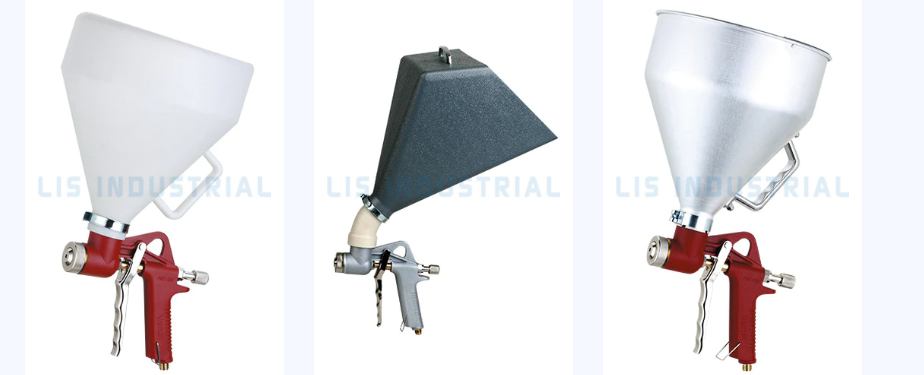
4. Texture Paint Spray Gun Frequently Asked Questions (FAQ)
- What is the difference between a texture paint spray gun and an ordinary spray gun?
Paint adaptability: Texture paint spray guns are designed for high-viscosity paints (containing quartz sand/glass beads) and have a larger nozzle diameter (usually ≥2.0mm), while ordinary spray guns are suitable for low-viscosity paints (1.3-1.8mm).
Atomization pressure: Texture paint spray guns require higher pressure (0.4-0.8MPa) to atomize particles, while ordinary spray guns only require 0.2-0.4MPa.
Wear resistance: The nozzle and needle valve of the texture spray gun are made of hard materials such as tungsten carbide, which are 3 times longer than ordinary spray guns.
- Why is the sprayed texture uneven?
Possible causes and solutions:
Unstable air pressure: Check whether the air compressor has achieved stable output (fluctuation <0.05MPa)
Nozzle wear: Aperture deformation >0.1mm needs to be replaced (measured with a vernier caliper)
Paint precipitation: Continuous stirring is required before construction to prevent aggregate stratification
- What should I do if the paint splashes severely during spraying?
Adjust parameters: reduce air pressure (0.3→0.25MPa) or increase spray distance (20→30cm)
Replace nozzle: select nozzle with smaller fan angle
Add rheological agent: improve paint thixotropy
- Can texture spray gun be used to spray ordinary latex paint?
Not recommended:
Ordinary latex paint has low viscosity, which will cause excessive atomization (paint waste rate>40%)
If it must be used, it is necessary to: replace small-caliber nozzle (≤1.5mm), and adjust the air pressure to below 0.2MPa
- How to deal with the residue after cleaning the spray gun?
Type treatment:
Water-based paint residue: soak in warm water + 5% ammonia water for 2 hours
Oil-based paint residue: soak in acetone (no more than 30 minutes)
- How often does the spray gun need comprehensive maintenance?
Daily maintenance: clean after each use
In-depth maintenance: every 50 working hours or once a month,
Including: dismantle and lubricate all seals, check whether the air passage is blocked, and calibrate the pressure regulating valve